

Disclosure: As an Amazon Associate, 1WAYCAMPING may earn a commission from qualifying purchases at no additional cost to you.
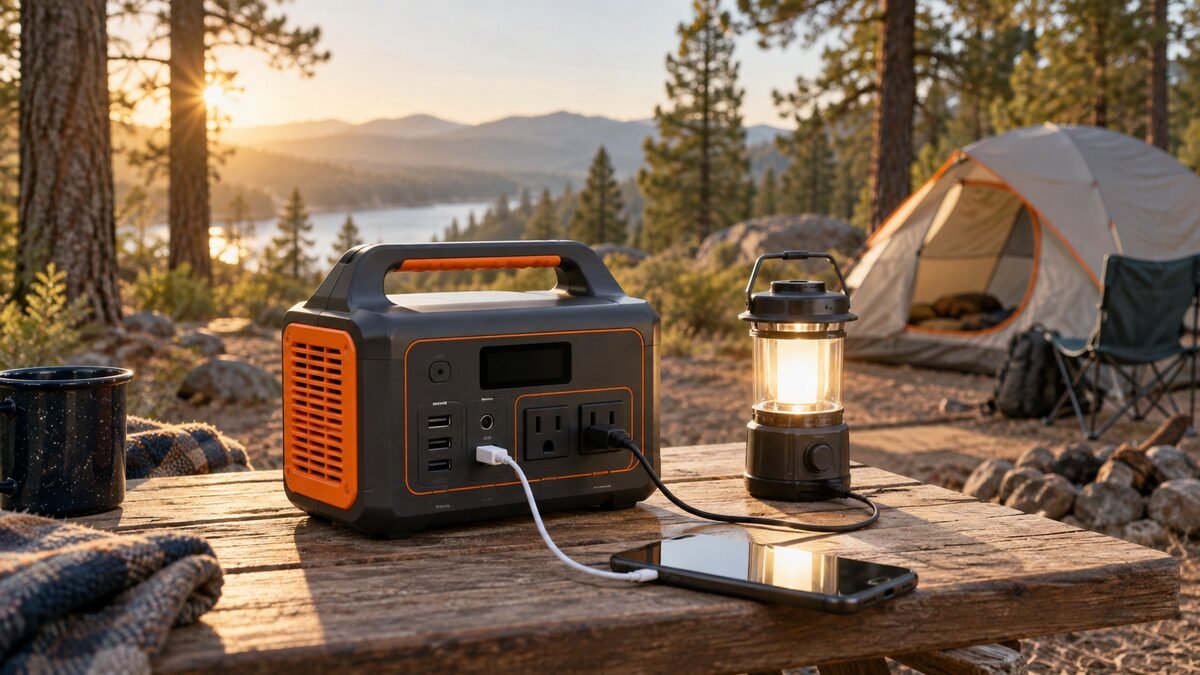
The OUPES Exodus 350 is a compact portable power station built for campers who need more capability than a power bank but do not want to carry a large home-backup battery. Its headline specifications are a 288Wh LiFePO4 battery and 350W output, placing it in the practical entry-level category for phones, lights, cameras, laptops, small fans, and selected low-power camping equipment.
This OUPES Exodus 350 review examines what those ratings mean at a real campsite, the types of devices it can reasonably support, important limitations, and who should consider a larger model. This is a research-based assessment of published specifications, not a claim of hands-on testing.
OUPES Exodus 350 at a Glance
- Battery capacity: 288Wh
- Rated output: 350W
- Battery chemistry: LiFePO4
- Product category: compact portable power station
- Primary uses: camping, road trips, mobile work, and light emergency backup
- Best for: personal electronics and low-wattage equipment
Available ports, included charging accessories, recharge times, price, and warranty terms can change by seller or variation. Confirm the current Amazon listing before ordering.
What Do 288Wh and 350W Mean?
The two main ratings describe different limits. Watt-hours measure stored energy, while watts describe how much power the station can deliver at one time. A 288Wh battery contains enough theoretical energy to supply 288 watts for one hour, 28.8 watts for ten hours, or another equivalent combination. Actual usable energy will be lower because the inverter, cables, battery management system, temperature, and connected device consume some power.
The 350W output limit determines which appliances can run. Every connected device must stay within the station’s continuous output rating, and motor-driven equipment may require a startup surge above its normal wattage. Capacity does not override output: a device that demands more than the supported wattage may trigger overload protection even when the battery is fully charged.
What Can the OUPES Exodus 350 Power?
The Exodus 350 is best treated as an electronics and comfort-device power source. It should be well suited to charging phones, tablets, action cameras, GPS units, rechargeable lanterns, and many laptops. It can also support some low-wattage fans, small projectors, routers, and compact camping accessories when their input rating remains below the station’s limit.
Approximate runtime can be estimated with this formula: usable watt-hours divided by device watts. For planning, assume less than the full 288Wh because conversion is never perfect. A 40W device may run for several hours, while a 200W device will drain the battery much faster. Cycling devices such as coolers complicate estimates because their compressors switch on and off.
Good Camping Uses
- Keeping several phones and cameras charged during a weekend.
- Powering LED campsite lighting without running a vehicle.
- Charging a laptop for remote work or entertainment.
- Operating a low-power fan after checking its label.
- Providing temporary power for a router or small electronics during an outage.
Equipment That May Be Too Demanding
- Electric kettles, coffee makers, and hot plates.
- Space heaters, hair dryers, and cooking appliances.
- Large refrigerators or equipment with a high compressor surge.
- Power tools that exceed the rated output.
- Any device whose label lists more than 350W or an unsupported startup requirement.
Never guess an appliance’s consumption from its size. Read the input label or use a watt meter before connecting it.
LiFePO4 Battery Advantages
Lithium iron phosphate, commonly written LiFePO4, is widely used in current portable power stations because it generally supports a long cycle life and strong thermal stability. For campers, that makes the Exodus 350 more appealing as a frequently used tool rather than a battery that remains forgotten in a closet.
Battery chemistry does not eliminate the need for correct care. Store the station within the manufacturer’s temperature range, keep vents clear, avoid standing water, and do not leave it in a hot vehicle. Recharge and inspect it periodically during long storage so it is ready when needed.
Portability for Camping and Road Trips
A 288Wh unit occupies a useful middle ground. It is more capable than a small USB power bank but considerably easier to move than a one- or two-kilowatt-hour home-backup station. That makes it practical for car camping, tailgating, picnics, photography trips, and emergency kits where space matters.
It is still not a backpacking battery. Even a compact power station adds significant weight compared with a phone charger. It works best when the vehicle is nearby or when the campsite can be reached with a short carry.
Charging the Exodus 350
Portable stations are commonly recharged from a wall outlet, vehicle connection, or compatible solar panel, but the supported inputs and maximum charging rate must be confirmed for this exact version. Charging from the wall is usually the most predictable method before a trip. Vehicle charging can extend road-trip use, while solar performance depends heavily on panel wattage, sun angle, shade, weather, and input limits.
A product described as a solar generator does not necessarily include a solar panel. Check the package contents carefully. When selecting a panel, confirm connector compatibility, voltage range, polarity, and maximum solar input rather than relying only on the advertised panel wattage.
Using a Portable Power Station Safely
- Keep the unit dry and protected from rain, condensation, and wet ground.
- Provide ventilation and never cover cooling openings.
- Do not operate or charge it inside an airtight container.
- Check the total running wattage of all connected devices.
- Inspect cables and connectors for damage before every trip.
- Use only charging equipment compatible with the manufacturer’s specifications.
- Stop using the unit if it becomes damaged, unusually hot, swollen, or produces an abnormal odor.
A battery power station does not produce exhaust like a gasoline generator, but connected cooking devices, heaters, and other equipment can still create fire or carbon-monoxide hazards. Follow the safety instructions for every appliance separately.
Pros and Cons
Pros
- Compact capacity class for car camping and travel.
- 288Wh provides meaningful energy for personal electronics.
- 350W output covers many low-power campsite devices.
- LiFePO4 chemistry is attractive for regular long-term use.
- No gasoline, fumes, pull cord, or engine maintenance.
Cons
- Not powerful enough for most electric heating or cooking appliances.
- Limited runtime for devices that draw close to 350W.
- Too heavy for normal backpacking.
- Solar charging depends on a compatible panel and good conditions.
- Buyers must verify current ports and included accessories.
Who Should Buy the OUPES Exodus 350?
This power station is a sensible match for solo campers, couples, photographers, road trippers, and families seeking a dedicated charging hub for small devices. It also fits a light emergency kit for communications, lighting, and selected electronics.
Choose a larger power station if you need to operate heating appliances, cooking equipment, a refrigerator for extended periods, medical equipment without a thoroughly verified backup plan, or several AC devices at once. Add the wattage of the planned equipment first, then choose capacity based on the required hours of use.
Final Verdict
The OUPES Exodus 350 offers a useful balance of portability and capability for light camping power. Its 288Wh LiFePO4 battery should handle a collection of personal electronics and low-wattage comfort devices, while the 350W output provides more flexibility than a conventional USB power bank.
Its value depends on realistic expectations. This is a compact charging and light-power station, not a substitute for a high-output generator. Campers who calculate their loads, verify the current ports and charging options, and stay within the rated output are the most likely to benefit from it.
Leave a Reply
You must be logged in to post a comment.