

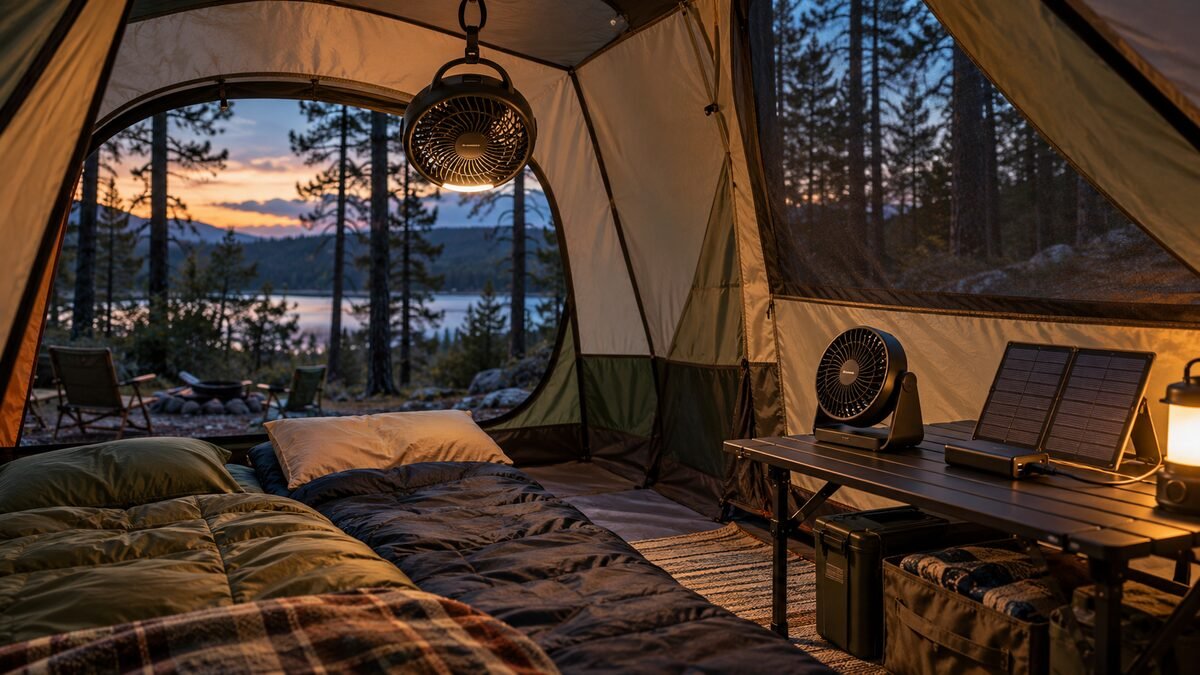
A rechargeable camping fan can improve airflow inside a tent, reduce stagnant heat, provide useful nighttime lighting, and even offer emergency charging. However, battery size alone does not determine which fan is right for a trip. Airflow, mounting options, noise, charging method, weather protection, and transportation all matter.
This guide explains how to evaluate rechargeable camping fans realistically so you can choose a model that fits your shelter, climate, and camping style.
1. Start With Your Type of Camping
The best fan for a drive-in family campground is rarely the best one for a long backpacking route. Before comparing battery numbers, decide how the fan will reach camp and where it will be used.
- Car camping: Larger batteries, oscillation, remote controls, and brighter lanterns are practical because weight is less important.
- Family tents: Look for strong airflow, a stable base, oscillation, and enough battery capacity for several sleeping positions.
- Backpacking: Prioritize low weight, compact dimensions, simple controls, and USB charging from an existing power bank.
- RV and van travel: A tabletop model with USB-C charging and multiple speeds offers flexibility.
- Emergency preparedness: Long storage life, a battery indicator, reliable charging, and power-bank output can be valuable.
2. Match Fan Size to the Shelter
Small personal fans work well near one sleeping bag, but they may not circulate air across a multi-room family tent. An 8- or 9-inch fan generally moves more air and can be useful in larger shelters, although it occupies more space and adds weight.
For two people in a compact tent, targeted airflow is often more efficient than trying to cool the entire interior. In a large cabin tent, an oscillating model can distribute air across several beds. Remember that a fan does not lower the actual air temperature; it improves comfort by moving air across the skin and reducing stuffiness.
3. Understand Battery Capacity and Runtime Claims
Manufacturers commonly advertise battery capacity in milliamp-hours, such as 10,000mAh, 20,000mAh, or 40,000mAh. A larger number usually indicates more stored energy when batteries use the same voltage, but mAh alone is not a perfect comparison. Watt-hours provide a more complete measurement because they account for voltage.
Advertised maximum runtime normally reflects the lowest fan speed with lighting and charging outputs turned off. High speed, bright LED settings, charging a phone, hot temperatures, cold weather, and battery age can reduce operating time.
A practical method is to estimate the number of hours you expect to run the fan each night and add a safety margin. For example, a three-night trip at eight hours per night requires at least 24 hours of realistic operation. Test a new fan at home on the exact setting you plan to use before depending on it outdoors.
4. Compare Airflow Settings, Not Just Maximum Speed
Three or four speeds provide more control over comfort and energy consumption. A gentle low setting may be quiet enough for sleeping and extend battery life, while a stronger setting helps during hot afternoons or tent setup.
If a manufacturer lists airflow in CFM, that number can help compare models, but grille design, blade size, distance, and oscillation also affect how the airflow feels. A fan that spreads air across a wide area may be more useful in a family tent than a powerful narrow stream.
5. Decide Between a Tabletop Base, Hook, or Oscillation
- Tabletop base: Easy to move and stable on level surfaces.
- Folding hook: Saves floor space and can direct air from above.
- Manual tilt: Helps aim airflow toward a sleeping area.
- Automatic oscillation: Better for wide tents and shared spaces.
Never hang a fan from a weak light loop unless the tent manufacturer indicates that the loop can support the weight. Keep the unit away from loose fabric, hair, straps, and bedding. A stable tabletop position is safer when there is any doubt about the support.
6. Consider Noise for Overnight Use
Fan noise can be soothing for some campers and distracting for others. Published decibel ratings are useful only when manufacturers measure them under similar conditions, which is not always the case. Reviews and home testing can reveal motor hum, clicking, vibration, or control beeps that specification sheets may not mention.
Place the fan on a solid surface to reduce vibration. Inside a quiet campground, low speed is usually the best balance of comfort, noise, and battery life.
7. Evaluate Lights, Remotes, and Timers
An integrated LED lantern can replace a separate ambient light, but it also consumes battery power. Adjustable brightness is preferable to a single intense setting. A remote is convenient when the fan hangs overhead or sits beyond easy reach, and a timer prevents unnecessary operation after you fall asleep.
Some models include a sleep mode that turns off indicator lights or reduces control sounds. This small feature can make a noticeable difference inside a dark tent.
8. Choose the Right Charging Method
USB-C Charging
USB-C is convenient because the same type of cable may work with a wall adapter, vehicle charger, power station, or power bank. Check the required voltage and current rather than assuming that every charger is compatible or equally fast.
Solar Charging
A separate solar panel can extend off-grid use by remaining in direct sunlight while the fan stays shaded. Solar charging speed changes with cloud cover, season, panel angle, shadows, and temperature. Consider it supplemental energy, and begin the trip with the fan fully charged by USB.
Power-Bank Output
Charging a phone from the fan is helpful in an emergency, but every phone charge reduces cooling time. If several people need dependable charging, carry a separate power bank or portable power station.
9. Look for Clear Battery Indicators
A percentage display or multi-level indicator is more useful than a single low-battery light. Knowing the remaining charge helps campers decide when to reduce speed, stop using the lantern, or connect a charger before bedtime.
10. Check Weather Protection and Durability
Many portable fans are intended for outdoor use but are not waterproof. Unless the manufacturer provides a specific water-resistance rating, protect the fan, charging port, remote, and solar connections from rain, splashes, and heavy condensation.
Inspect the grille, hook, stand, and charging port before every trip. A wide base reduces tipping, while recessed controls are less likely to activate accidentally inside a gear bag.
Rechargeable Camping Fan Safety
- Keep air intakes and outlets unobstructed.
- Do not cover the fan with blankets or clothing.
- Keep fingers, hair, cords, and loose fabric away from the grille.
- Do not leave a lithium-battery fan inside a hot closed vehicle.
- Use the recommended charging cable and power source.
- Recharge the battery periodically during long-term storage.
- Stop using the fan if it becomes swollen, damaged, unusually hot, or produces an odor.
Quick Buying Checklist
- Will you carry the fan by vehicle or in a backpack?
- How many people and sleeping areas need airflow?
- How many hours will it run each night?
- Is the advertised runtime measured on low speed?
- Do you need a hanging hook or automatic oscillation?
- Are adjustable lighting, a timer, or a remote important?
- Can it recharge from your existing USB equipment?
- Do you have a backup charging method?
- Is the fan protected from rain and condensation?
- Can the battery be stored and maintained safely?
Frequently Asked Questions
How large should a camping fan battery be?
For a weekend car-camping trip, 10,000mAh to 20,000mAh may be sufficient when the fan operates mainly on low speed. Larger 24,000mAh to 40,000mAh models provide more flexibility for longer trips, higher speeds, lighting, and emergency charging, but they are heavier.
Can a fan make a tent cooler?
A fan does not lower the outdoor temperature, but moving air can make occupants feel cooler and reduce stagnant, humid air. Opening the tent’s designed ventilation panels can improve circulation.
Is a solar camping fan worth it?
It can be worthwhile for sunny multi-day trips with enough open space to position the panel. In shaded forests or cloudy weather, USB charging will be more dependable.
Final Advice
Choose a rechargeable camping fan by matching its realistic runtime, airflow pattern, mounting design, noise, and charging options to the way you actually camp. The largest battery is not automatically the best choice if it adds unnecessary weight, and the lightest fan may not move enough air for a family shelter.
For examples of how different battery sizes and features compare, read our best rechargeable camping fans comparison for 2026.
Leave a Reply
You must be logged in to post a comment.