

Disclosure: As an Amazon Associate, 1WayCamping may earn from qualifying purchases made through links in this article, at no extra cost to you.
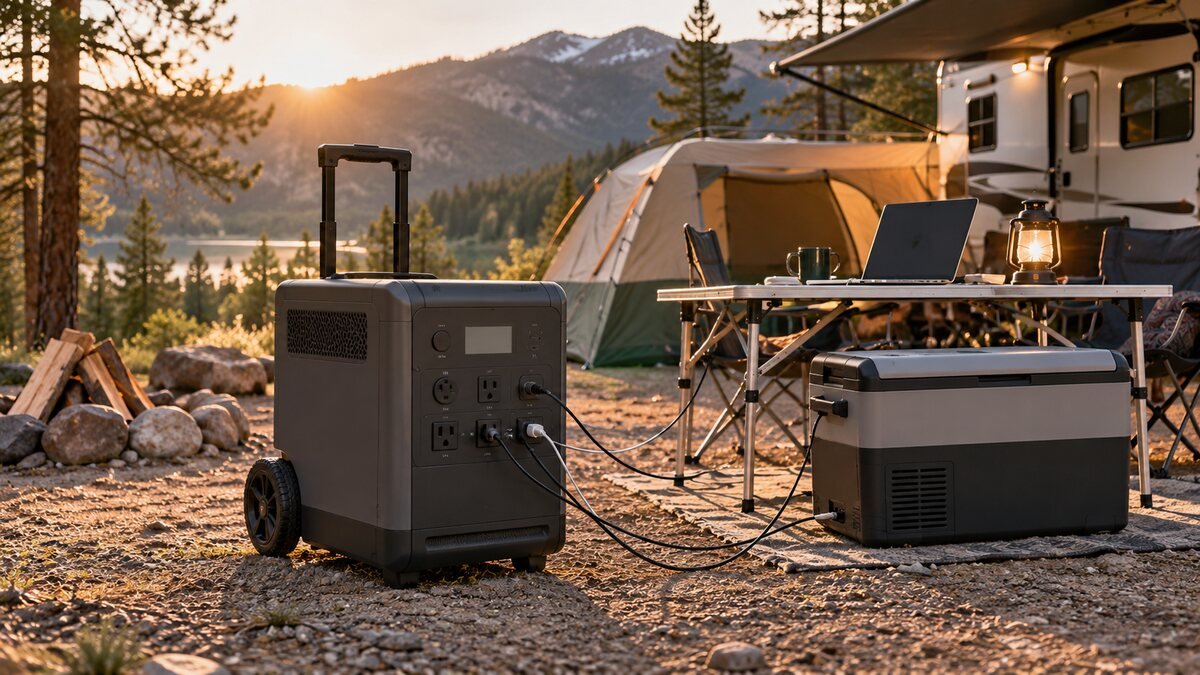
The original EF ECOFLOW DELTA Pro is built for jobs that smaller portable power stations cannot comfortably handle. With a 3600Wh LiFePO4 battery, 3600W of continuous 120V AC output, wheels, multiple charging options, and an expandable energy ecosystem, it can support a well-equipped RV site, an off-grid base camp, or selected home appliances during an outage. This EcoFlow DELTA Pro review explains its real advantages, important limitations, and the type of buyer who can make good use of its considerable size and capacity.
EcoFlow DELTA Pro specifications
- Battery capacity: 3600Wh
- Battery chemistry: LiFePO4 (LFP)
- AC output: 3600W continuous at 120V
- Surge output: up to 7200W
- Expandable capacity: up to 10.8kWh with compatible extra batteries
- Solar input: up to 1600W under supported conditions
- Cycle life: approximately 3,500 cycles to 80% capacity
- Weight: approximately 99 lb (45 kg)
- Mobility: built-in wheels and telescoping handle
- Control: onboard display and EcoFlow app connectivity
The specifications make clear that this is transportable equipment rather than a lightweight battery. It belongs in an RV, garage, workshop, cabin, or vehicle-accessible campsite. The wheels and handle help on firm, level ground, but lifting a 99-pound unit into a vehicle may require two people and careful technique.
What can 3600Wh do?
A 3600Wh battery offers much more headroom than the typical 1kWh camping power station. It can power communications equipment, lights, laptops, a portable refrigerator, fans, and other campsite essentials for extended periods, depending on their demand. It can also support selected household appliances during an outage.
Rated capacity is not identical to energy delivered at an AC outlet. Conversion losses, temperature, inverter consumption, battery condition, and the appliance’s duty cycle all affect runtime. A useful estimate is to multiply the rated capacity by a conservative efficiency factor and divide by the appliance’s average wattage. Devices with compressors, pumps, and heating elements can have startup or cycling behavior that makes simple estimates less accurate.
3600W AC output and 7200W surge
The 3600W continuous inverter is one of the DELTA Pro’s defining strengths. It can operate several moderate loads or a single demanding appliance when the combined continuous draw remains within the limit. The 7200W surge rating is intended for short startup spikes and should never be treated as a continuous-output specification.
Before connecting equipment, check both its running wattage and startup demand. Large air conditioners, electric heaters, cooking appliances, or pumps can consume the battery quickly even when their wattage is technically supported. For critical household circuits, installation hardware and electrical work should be selected and installed by qualified professionals.
Charging options and solar performance
The DELTA Pro supports charging from a standard AC outlet, compatible solar arrays, vehicle sources, and selected EcoFlow accessories. Official specifications list solar input up to 1600W. Solar charging can be valuable for extended camping, but maximum input requires properly matched panels, voltage, connectors, strong sunlight, and favorable positioning.
Real solar production changes throughout the day and often falls below the panels’ nameplate rating because of clouds, shade, heat, angle, and wiring losses. A 3600Wh battery therefore needs realistic planning. Campers should compare daily energy consumption with the amount their array can reasonably replace, rather than assuming one sunny hour will restore the entire battery.
LiFePO4 battery and long-term use
EcoFlow rates the LFP battery for approximately 3,500 cycles before it reaches 80% of its original capacity under specified conditions. That does not mean the battery stops working at that point; it means its available capacity gradually decreases. LiFePO4 chemistry is widely favored in frequently cycled power stations because of its long service life and thermal stability.
Good ownership habits still matter. Keep the ventilation openings unobstructed, protect the unit from rain and standing water, avoid storing it at extreme temperatures, and follow EcoFlow’s guidance for charging during long periods of storage. It should never operate inside a sealed compartment where heat cannot escape.
Expandable power for RV and home backup
A single DELTA Pro starts at 3.6kWh and can expand to 10.8kWh with two compatible Smart Extra Batteries. EcoFlow also offers ecosystem accessories for RV and home-backup applications. Those additions can make the system more capable, but they also increase cost, weight, space requirements, and installation complexity.
For an RV owner, the high-capacity battery and strong inverter can reduce generator use at quiet campsites. For home backup, it can keep selected essentials running while avoiding fuel storage and exhaust. It is not automatically a whole-home solution, however. The appropriate configuration depends on the circuits, peak loads, outage duration, and local electrical requirements.
Portability: the biggest tradeoff
The built-in wheels and telescoping handle are helpful, but the approximately 99-pound weight is the product’s clearest limitation. It rolls best across a solid surface; gravel, stairs, mud, and uneven trails can be difficult. This is not a backpacking power station and is less convenient for campers who frequently change sites without a vehicle.
Pros and cons
Pros
- Large 3600Wh capacity
- Strong 3600W continuous AC output
- Long-life LiFePO4 battery chemistry
- Expandable to 10.8kWh with compatible batteries
- Multiple charging options, including substantial solar input
- Wheels, handle, display, and app-based monitoring
Cons
- Approximately 99 pounds and difficult to lift alone
- Higher purchase price than smaller camping stations
- Solar panels and expansion accessories may be sold separately
- Energy-intensive heating and cooling can drain the battery quickly
- Full home integration can require additional hardware and professional installation
Who should buy the EcoFlow DELTA Pro?
The DELTA Pro makes the most sense for RV travelers, serious car campers, cabin owners, mobile professionals, and households that want substantial portable backup capacity. It is especially attractive when expansion or solar charging may be added later. Casual campers who only need phone charging and lights will usually save money and space with a smaller unit.
Final verdict
The EF ECOFLOW DELTA Pro combines 3600Wh of storage with 3600W of continuous 120V AC output in a mature, expandable platform. Its capacity, LFP battery, strong inverter, and flexible charging options are compelling for RV use, base camps, and selected home-backup needs. Its 99-pound weight and premium ecosystem costs are real drawbacks. Buyers who genuinely need several kilowatt-hours of portable energy—and have a practical way to move it—will find it far more useful than those shopping for a simple weekend charging box.
Leave a Reply
You must be logged in to post a comment.