

Disclosure: As an Amazon Associate, 1 Way Camping earns from qualifying purchases at no extra cost to you.
The best camping water filters are not interchangeable. A personal straw is light and inexpensive, a gravity system can supply a group, a purifier bottle may address viruses, an electric pump reduces effort, and a stainless-steel unit works well from a stable base camp. Choosing by product name alone can leave you with too little capacity—or protection that does not match the water source.
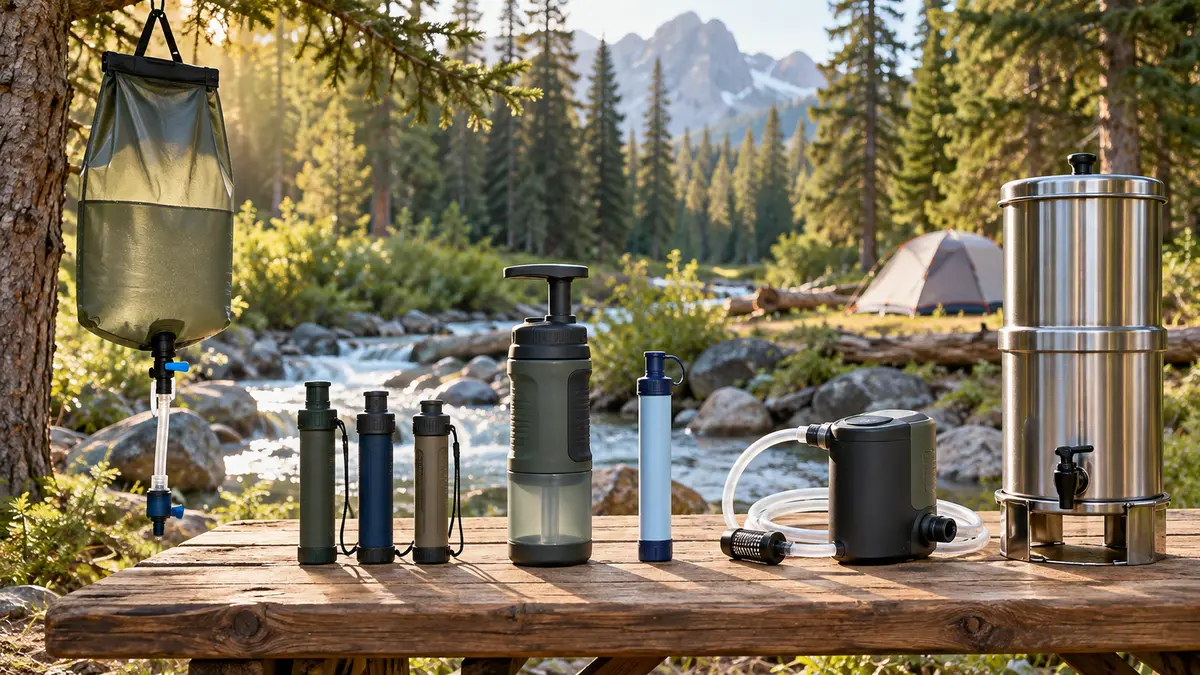
This guide compares six systems previously reviewed by 1 Way Camping: the Practical Survival Gravity Kit, Practical Survival filter straws, GRAYL GeoPress, LifeStraw Personal, a 3-in-1 portable electric filter, and the Go Berkey kit. We compare their format, capacity, treatment claims, portability, maintenance, and ideal use. Specifications and performance claims should always be confirmed on the current listing and manufacturer documentation.
Quick Comparison
| Product | Format | Best for | Key limitation |
|---|---|---|---|
| Practical Survival Gravity Kit | Dual-bag gravity system | Groups and base camps | Needs hanging space and cleaning |
| Practical Survival Straws | Five personal filter straws | Family emergency distribution | No shared clean-water reservoir |
| GRAYL GeoPress | Press-style purifier bottle | Travel and broad pathogen protection | Shorter cartridge capacity and higher cost |
| LifeStraw Personal | Individual filter straw | Budget backup and ultralight kits | Standard model does not remove viruses |
| 3-in-1 Electric Filter | Powered pump with manual backup | Convenient container filling | Limited independent documentation |
| Go Berkey Kit | One-quart stainless gravity system | RVs, cabins, hotels, and car camping | Small capacity and relatively bulky |
Our Recommendations at a Glance
- Best overall purifier bottle: GRAYL GeoPress
- Best for groups: Practical Survival Gravity Kit
- Best budget personal backup: LifeStraw Personal
- Best multi-person emergency pack: Practical Survival 5-Pack Straws
- Best for powered convenience: 3-in-1 Portable Electric Filter
- Best for a stable travel setup: Go Berkey Kit
1. Practical Survival Gravity Water Filtration System — Best for Groups
The six-piece Practical Survival kit uses separate dirty- and clean-water bags, a filter, a cleaning plunger, and a carrying bag. The manufacturer listing describes six-liter bags and a filter lifespan claim of up to 1,800 gallons. Once suspended, gravity moves water through the filter without batteries or continuous pumping.
This format makes the most sense for families, shared campsites, hunting camps, and emergency storage. It can process water while other tasks are handled, and the clean bag provides a useful reservoir. The disadvantages are setup space, slower operation than some powered or press-style systems, and the need to keep dirty hoses and fittings separated from clean components.
2. Practical Survival Filter Straws 5-Pack — Best for Family Emergency Kits
This five-pack distributes independent filters among several people instead of relying on one central device. The company describes each straw as approximately eight inches long, two ounces in weight, reusable, and capable of a high total filtration volume. That makes the package attractive for bug-out bags, vehicles, evacuation kits, or group preparedness.
The main strength is redundancy: one lost or clogged unit does not disable the entire group. However, filter straws are less convenient for filling cooking pots or producing stored clean water. Seller lifespan and contaminant-reduction claims should be checked against current test documents for the exact model.
3. GRAYL GeoPress 24 oz — Best Overall Purifier Bottle
The 24-ounce GRAYL GeoPress stands apart because the manufacturer markets it as a purifier rather than a basic microfilter. GRAYL states that it removes viruses, bacteria, and protozoa while filtering particulates, microplastics, and selected chemicals. Water is collected in the outer cup and forced through the replaceable cartridge by pressing the inner bottle downward.
GRAYL rates the cartridge for approximately 350 cycles or 65 gallons, with replacement also indicated when press time becomes unusually long. It is an appealing choice for international travel, uncertain water sources, and campers who want treated water stored in the same bottle. Its higher purchase price, physical pressing effort, and lower total cartridge volume make it less economical for supplying a large group.
4. LifeStraw Personal — Best Budget and Ultralight Backup
The LifeStraw Personal is the simplest option in this comparison. LifeStraw lists a 0.2-micron membrane, protection against bacteria, parasites, microplastics, silt, sand, and cloudiness, and a capacity of up to 1,000 gallons or 4,000 liters. It is compact enough for daypacks, glove boxes, and emergency bins.
Its simplicity is also its limitation. The standard personal model is designed for drinking directly from a source or container and does not remove viruses. It does not automatically provide a supply of clean water for cooking or washing. It works best as an inexpensive backup rather than the only treatment method for every destination.
5. 3-in-1 Portable Electric Water Filter — Best for Convenience
This compact system is advertised with electric pumping, solar support, a manual backup, an eight-stage treatment system, a 0.01-micron filtration rating, and an integrated LED. Powered operation can make filling bottles and cooking containers easier than repeatedly squeezing or manually pumping.
The concept is versatile, but this relatively new product has limited independent documentation. Buyers should verify battery capacity, liters per charge, solar charging time, absolute versus nominal pore size, laboratory reports, replacement cartridges, and warranty coverage. The manual backup is valuable, yet batteries, electronics, tubing, and seals introduce more potential failure points than a simple straw.
6. Go Berkey 1-Quart Kit — Best for RVs and Car Camping
The Go Berkey kit uses a compact one-quart stainless-steel gravity system. The listing identifies gravity-fed operation, activated carbon and ion exchange, a sport bottle, a filter element, and a Black Berkey Primer. It requires no electricity and offers a more permanent countertop-style arrangement than a soft bag or straw.
This model is most practical in an RV, cabin, hotel room, or established car campsite. At roughly 2.4 pounds with only one quart of capacity, it is not ideal for ultralight backpacking or quickly serving a family. Confirm seller authenticity, current bundle contents, performance documentation, return policy, and manufacturer warranty before ordering through a marketplace.
Filter vs. Purifier: The Most Important Difference
A conventional portable microfilter may remove parasites and bacteria but not viruses. A purifier is designed and tested for broader pathogen protection, including viruses. The distinction matters more in areas affected by sewage, crowded settlements, international travel, or disaster conditions than at a protected backcountry source.
The CDC advises following the manufacturer’s instructions and, when viral contamination is possible, using a treatment method appropriate for viruses. Filtering first and then applying a suitable disinfectant can provide broader protection. Boiling remains a reliable germ-killing method when fuel is available and the source is not chemically contaminated.
How to Choose the Right System
Choose by group size
Solo hikers can prioritize weight and simplicity. Couples may prefer a purifier bottle or electric pump. Families and base camps benefit from a gravity reservoir that produces several liters without constant attention.
Match the treatment to the source
Research likely contaminants before the trip. Standard filters are useful for many freshwater sources but should not automatically be trusted against viruses, salt, fuel, pesticides, heavy industrial contamination, or harmful algal toxins.
Consider output and storage
A straw supports immediate personal drinking. A bottle stores one serving. A gravity bag or powered pump can fill multiple containers. Decide whether you need only hydration or also water for meals, pets, hygiene, and other campers.
Plan for maintenance
Every system requires care. Check priming, backwashing, cartridge replacement, freezing precautions, drying, and storage instructions. Carry a backup method because filters can clog, freeze, crack, become contaminated, or simply be misplaced.
Final Verdict
There is no single winner for every camper. The GRAYL GeoPress is the most complete all-in-one option when verified virus protection matters. The Practical Survival Gravity Kit is the more practical choice for groups. The LifeStraw Personal is an excellent lightweight backup, while the five-pack Practical Survival straws distribute redundancy across a family.
The 3-in-1 electric filter favors convenience but demands closer verification of its technical claims. The Go Berkey provides a durable, electricity-free setup for vehicle-based travel. Choose according to source-water risk, verified test results, group size, output needs, packing space, and access to replacement parts—not marketing claims alone.
Prices, availability, specifications, warranties, and performance claims can change. Confirm the current Amazon listings and manufacturer documentation before purchasing or relying on any water-treatment product.
Leave a Reply
You must be logged in to post a comment.