

Disclosure: As an Amazon Associate, 1 Way Camping earns from qualifying purchases at no extra cost to you.
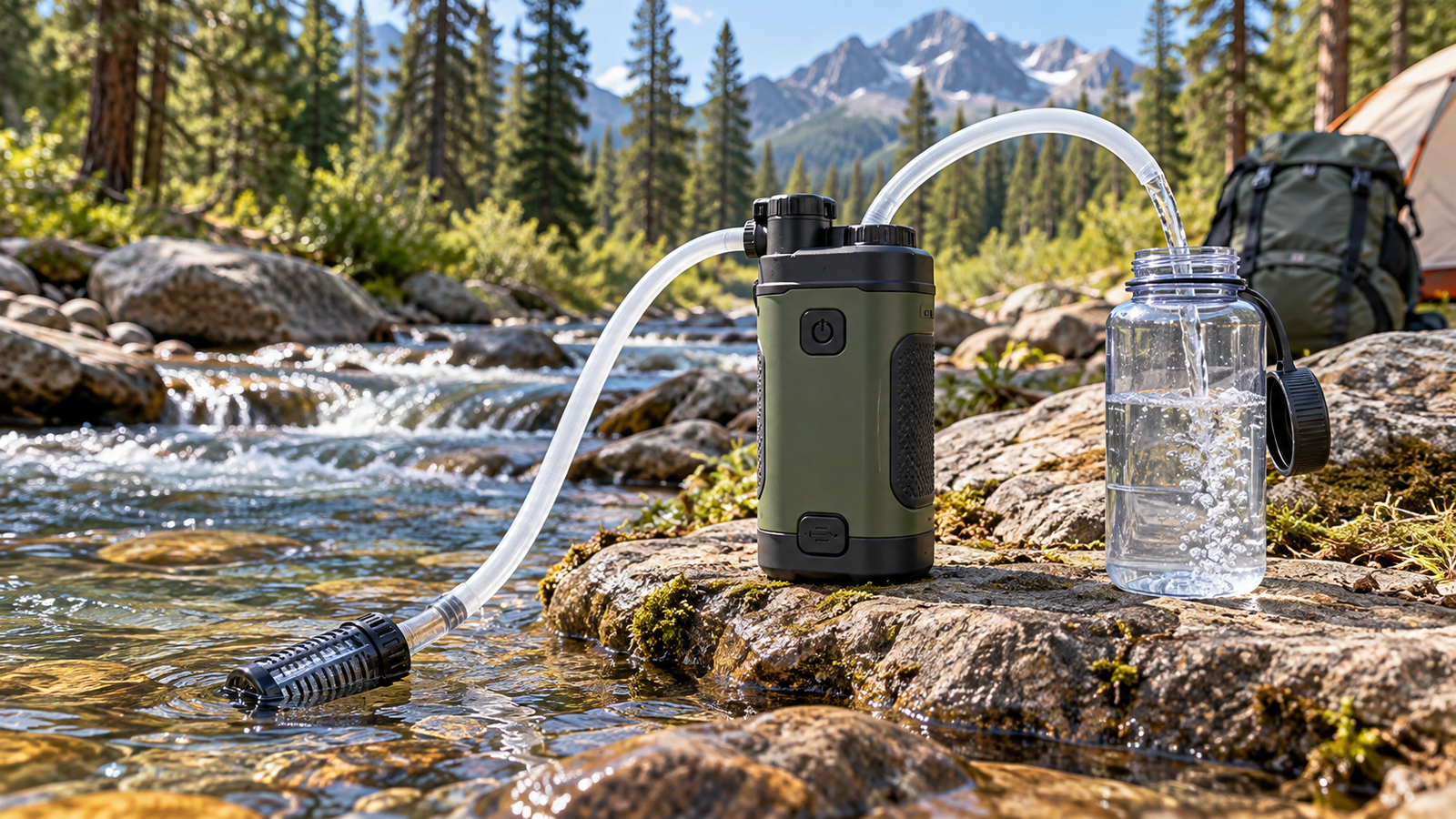
The 3-in-1 portable electric water filter is designed for emergency kits, camping, hiking, travel, and off-grid situations where manually pumping every liter may be inconvenient. The Amazon listing promotes three operating options—electric pumping, solar support, and a manual backup—along with an eight-stage treatment system, built-in LED light, and a stated 0.01-micron filtration rating.
This combination is ambitious for a compact device. Electric operation can make collecting water easier, while the manual mode provides a fallback if the battery is depleted. However, this appears to be a relatively new product with limited independent documentation. Buyers should verify the current seller specifications, certifications, replacement-filter availability, battery details, and full instruction manual before depending on it in an emergency.
Key Features at a Glance
| Product type | Portable powered water-filtration system |
|---|---|
| Operating modes | Electric, solar-supported, and manual backup, according to the listing |
| Filtration system | Advertised eight-stage treatment |
| Stated filtration rating | 0.01 micron |
| Advertised capacity | Approximately 265 gallons |
| Additional feature | Integrated LED light |
| Best for | Emergency kits, vehicle camping, base camps, and preparedness |
What “3-in-1” Means
The listing presents the product as more than a standard rechargeable pump. Electric operation is intended to move water through the filter automatically. Solar support provides another way to maintain power in the field, while the manual-pump function is designed to keep the unit usable when charging is unavailable.
That redundancy is attractive for preparedness. A battery-only device can become dead weight when power runs out, but a manual option may preserve basic filtration capability. Still, buyers should confirm whether the solar component charges the internal battery directly, how long charging takes, and exactly how the hand-pump mode is operated. Those details were not independently verified for this review.
Eight-Stage Filtration and 0.01-Micron Claim
The seller advertises an eight-stage filtration process and a 0.01-micron rating. In general, a filtration level this fine would fall into ultrafiltration territory and may be capable of addressing bacteria, protozoa, and many viruses. The CDC notes that ultrafilters around 0.01 micron should be effective against viruses, bacteria, and parasites.
However, pore size alone does not prove the complete performance of a finished product. The listing should identify whether 0.01 micron is an absolute or nominal rating, which contaminants were tested, the testing laboratory, applicable standards, and performance throughout the filter’s service life. Until those details are confirmed, virus-removal claims should be treated cautiously rather than as a guarantee.
Electric Convenience in Camp
A powered pump can fill a bottle or cooking container without repeated squeezing or direct drinking from a straw. This makes the format useful for car camping, small groups, and emergency water collection. Separate intake and outlet hoses can also help keep untreated water away from the clean container when they are handled correctly.
The disadvantages are added complexity and weight. Batteries, seals, electronics, tubing, and multiple filter stages create more potential failure points than a simple gravity bag or filter straw. Users should practice assembly, priming, manual pumping, cleaning, and disassembly before relying on the unit outdoors.
Battery, Solar Charging, and LED Light
The LED light may be convenient during nighttime filtration or power outages, but it also consumes battery energy. Water treatment should take priority over lighting when remaining charge is limited. Keep a separate headlamp in the emergency kit rather than treating the filter’s light as the only illumination source.
Solar charging can be useful, but small integrated panels are generally sensitive to sunlight angle, weather, and exposure time. Confirm the actual battery capacity, charging connection, expected solar charging time, number of liters per charge, and whether the unit can operate while charging. Carrying a compatible power bank may be more predictable than relying solely on sunlight.
Understanding the 265-Gallon Capacity
The listing associates this system with a capacity of approximately 265 gallons. Treat that number as a maximum seller claim under specified conditions. Mud, algae, fine sediment, improper storage, insufficient cleaning, and highly contaminated water can reduce flow or shorten useful filter life.
Prefilter cloudy water through a clean cloth and allow sediment to settle before placing the intake hose. Replace filter elements according to the manual, even if the theoretical capacity has not been reached. A slow flow, unusual taste, damage, or improper storage may indicate that service is needed sooner.
What We Like
- Electric pumping reduces manual effort
- Manual backup adds preparedness value
- Solar support may extend field usability
- Eight-stage system addresses several water-quality concerns
- Separate hoses make bottle filling practical
- Built-in LED can help during outages
What to Consider
- Limited independent product documentation
- 0.01-micron and virus claims need verified test details
- Battery runtime and solar charging performance may vary
- More components mean more cleaning and maintenance
- Replacement-filter cost and availability should be checked
- Not designed to desalinate seawater or solve every chemical hazard
Water-Safety Limitations
No portable system should be assumed to make every source safe. Avoid water near industrial runoff, mines, farms, sewage, fuel spills, harmful algal blooms, or obvious chemical contamination. Unless the seller provides specific verified claims, do not assume the device removes salt, pesticides, fuel, or all dissolved heavy metals.
Follow public-health instructions during an outbreak or disaster. If there is uncertainty about viral performance, filtration can be followed by an appropriate disinfection method. Boiling remains the most reliable way to kill germs when it is practical and the water is not chemically contaminated.
Final Verdict
The 3-in-1 portable electric water filter has an appealing preparedness concept: powered convenience, solar support, manual backup, multiple filter stages, and an integrated light in one portable package. It is particularly suited to vehicle kits, base camps, emergency storage, and users who prefer automatic pumping.
The product’s broad claims also demand careful verification. Before making it a primary emergency treatment system, confirm its certified contaminant reductions, absolute pore rating, battery runtime, output rate, replacement schedule, warranty, and access to replacement cartridges. Used according to verified instructions and paired with sensible source selection, it may be a versatile addition to a broader water-preparedness plan.
Specifications, accessories, and performance claims can change. Confirm the current Amazon listing and included instruction manual before purchasing or using this product.
Leave a Reply
You must be logged in to post a comment.