

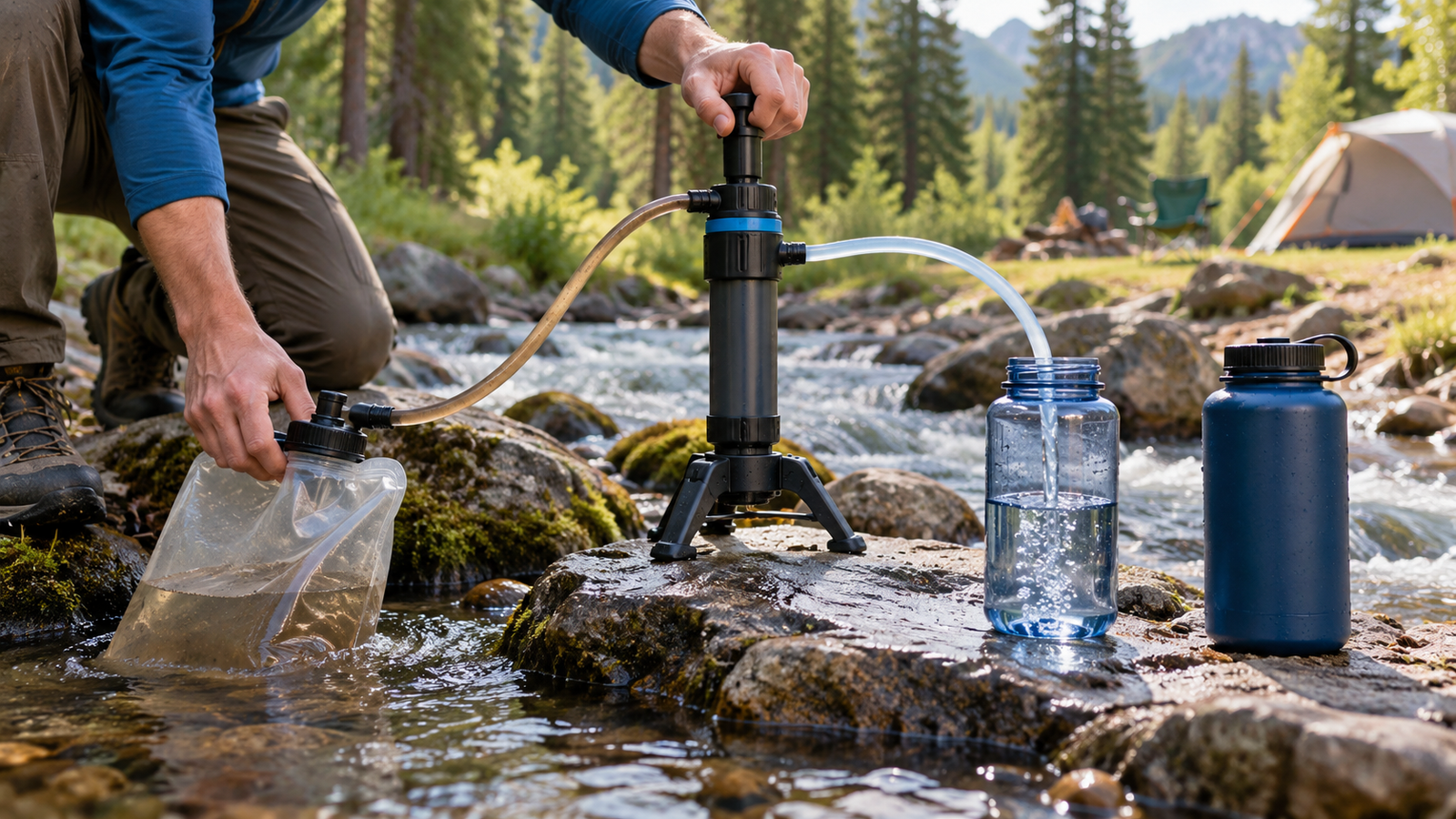
Knowing how to choose a camping water filter is about more than comparing weight and price. The right system must match the microorganisms and other hazards that may be present, the number of people in your group, the amount of water you need, and the way you travel.
Clear mountain water is not automatically safe. Bacteria, viruses, and parasites can be present without changing its color, smell, or taste. Filters also have important limits: many do not remove viruses, dissolved chemicals, salt, or toxins from harmful algal blooms. This guide explains the main treatment methods and how to use them responsibly.
Start With the Water Source
Before choosing equipment, consider where the water comes from. A protected backcountry spring presents different risks than a river downstream from livestock, a flood-affected neighborhood, or a water supply in a country with unreliable sanitation.
- Backcountry streams and lakes: parasites and bacteria are usually the primary concerns, although viruses may be possible near heavy human activity or sewage.
- Flood and disaster water: may contain sewage, fuel, pesticides, industrial chemicals, and debris. A small camping filter cannot be assumed to make it safe.
- International travel: viral contamination may be a greater concern, making a verified purifier or combined treatment more appropriate.
- Saltwater: conventional camping filters do not desalinate. Reverse osmosis or distillation is required.
When possible, choose moving water upstream from camps, grazing animals, roads, and obvious contamination. Avoid water with oily films, unusual colors or odors, dead wildlife, industrial runoff, mining residue, or visible algal blooms.
Filter vs. Purifier
A filter physically removes particles and selected microorganisms as water passes through pores. Many common backpacking microfilters are designed for protozoa and bacteria, but not viruses. A purifier is designed to provide broader pathogen protection, normally including viruses, when used according to its verified instructions.
The CDC states that an absolute pore size of 0.3 micron or smaller can remove bacteria and parasites but not viruses. A rating of one micron or smaller may remove parasites but not necessarily all bacteria. Pay attention to the word absolute: a nominal rating can allow some larger particles to pass.
Common Camping Water-Treatment Methods
Personal filter straws
Straws are compact, inexpensive, and useful as emergency backups. They are best for one person drinking directly from a water source or container. Their main limitations are low shared capacity and difficulty producing stored clean water for meals or other campers.
Squeeze filters
A soft dirty-water pouch forces water through a small filter. This format balances weight, speed, and versatility for backpacking. Pouches can wear out, flow can slow as the filter clogs, and many models require frequent backwashing.
Gravity filters
Gravity systems hang above a clean container and process water with little physical effort. They are excellent for families, groups, and established camps. They require hanging space, careful hose management, and more storage room than most personal filters.
Pump filters
Manual pumps draw water from shallow or difficult sources and deliver it directly into a bottle. They provide control over output but require effort and contain moving parts that need cleaning and maintenance.
Purifier bottles
Press-style or cartridge-based purifier bottles combine collection, treatment, and storage. Models with verified virus-removal performance can be useful for travel and uncertain sources. Replacement cartridges may cost more and usually treat less total water than a basic microfilter.
Electric filters
Battery-powered pumps reduce manual work and can fill containers conveniently. Look for documented runtime, output per charge, manual backup, waterproofing, filter availability, and credible performance testing. Electronics add weight and additional failure points.
Chemical disinfection
Chlorine, iodine, and chlorine-dioxide products can kill viruses and bacteria when used at the correct dose and contact time. Some chemicals are less effective against certain parasites, especially in cold or cloudy water. Follow the product label exactly and consider medical restrictions, taste, and treatment time.
Ultraviolet treatment
Portable UV devices can inactivate bacteria, viruses, and parasites in small amounts of clear water. Cloudiness can shield microorganisms from the light, so prefiltration may be needed. UV devices also depend on batteries and do not remove particles or chemicals.
Boiling
Boiling is the most reliable way to kill germs when fuel and a suitable pot are available. CDC guidance calls for a rolling boil for one minute, or three minutes above 6,500 feet. Boiling does not remove salt, fuel, heavy metals, pesticides, or other chemical contaminants.
How to Read Filter Specifications
| Specification | Why it matters |
|---|---|
| Absolute pore size | Indicates the largest pore limit more reliably than a nominal rating |
| Pathogen claims | Shows whether bacteria, parasites, and viruses are individually addressed |
| Test standard | Helps distinguish verified performance from general marketing language |
| Flow rate | Determines how long it takes to supply one person or a group |
| Filter lifespan | Estimates capacity under specified test conditions |
| Replacement availability | A system is only useful if compatible cartridges can be obtained |
| Freezing instructions | Wet hollow-fiber membranes can be damaged by freezing |
| Weight and packed size | Influences suitability for backpacking, vehicle travel, or base camps |
Understanding NSF Standards
Certification should be read at the level of the specific claim, not just the standard number. NSF explains that Standard 42 generally addresses aesthetic effects such as chlorine, taste, and odor. Standard 53 covers specified health-related contaminant reductions. Standard 58 applies to reverse-osmosis systems.
A filter is not certified to remove every contaminant merely because an NSF number appears on the packaging. Check the certified product database and confirm the exact model and contaminant claim. Manufacturer testing can also be useful, but the laboratory, protocol, conditions, and complete results should be clearly available.
Choose Capacity for Your Group
Think beyond drinking water. Camp water may also be needed for cooking, hot beverages, pets, and basic hygiene. A personal straw can work for a day hike but becomes inconvenient when several liters must be collected for dinner. A gravity bag is heavier but can serve several people while unattended.
- Solo day hike: personal straw, squeeze filter, or compact purifier bottle
- Backpacking trip: lightweight squeeze or gravity filter plus backup tablets
- Family campsite: high-capacity gravity system with clean-water storage
- International travel: verified purifier, boiling, or filtration followed by disinfection
- Emergency kit: redundant methods that work without electricity
- RV or cabin: larger gravity or countertop system with accessible replacement cartridges
Safe Collection and Cross-Contamination Prevention
Even an effective filter can be defeated by poor handling. Clearly identify dirty-water bags, hoses, and bottle threads. Do not allow the dirty outlet, hands, or container exterior to touch the clean-water opening. After treating water, dry the outside of the clean bottle or wipe it with treated water.
Collect from below the surface when possible, avoiding bottom sediment and floating debris. Let very cloudy water settle and prefilter it through a clean cloth. Prefiltration improves flow and filter life, but it does not make water microbiologically safe by itself.
Maintenance and Storage
- Prime new elements exactly as instructed.
- Backwash or clean only by the approved method.
- Never use untreated water on the clean side.
- Protect wet hollow-fiber filters from freezing.
- Replace damaged housings, seals, hoses, or cartridges.
- Allow components to dry according to the storage instructions.
- Record first-use dates and estimated treated volume.
- Test the system before every major trip.
Common Mistakes to Avoid
- Assuming clear water is safe
- Treating “0.1 micron” as proof of virus removal
- Confusing better taste with complete purification
- Using a camping filter on saltwater or chemical spills
- Ignoring replacement and cleaning instructions
- Letting a wet membrane freeze
- Cross-contaminating clean containers
- Depending on one device without a backup
A Simple Decision Checklist
- Identify the likely biological and chemical hazards.
- Decide whether you need a filter or verified purifier.
- Calculate daily water needs for the entire group.
- Choose a format that fits your travel style.
- Verify contaminant-specific testing and certification.
- Check flow rate, lifespan, and cartridge availability.
- Review freezing, cleaning, and storage requirements.
- Carry a suitable backup treatment method.
Final Thoughts
The best camping water-treatment system is the one that matches the source, treats the relevant hazards, produces enough water, and can be maintained correctly in the field. For many backcountry trips, a quality microfilter plus a backup disinfectant provides useful flexibility. For international travel or sewage-related contamination, broader virus protection deserves greater priority.
No compact filter makes every water source safe. When chemical pollution is suspected, choose another source. Follow current public-health guidance during disasters and boil-water advisories, and verify the instructions and testing for the exact product you carry.
This article provides general outdoor-safety information and is not a substitute for local public-health instructions or product-specific directions.
Leave a Reply
You must be logged in to post a comment.