

Disclosure: As an Amazon Associate, 1 Way Camping earns from qualifying purchases. This does not affect the price you pay.
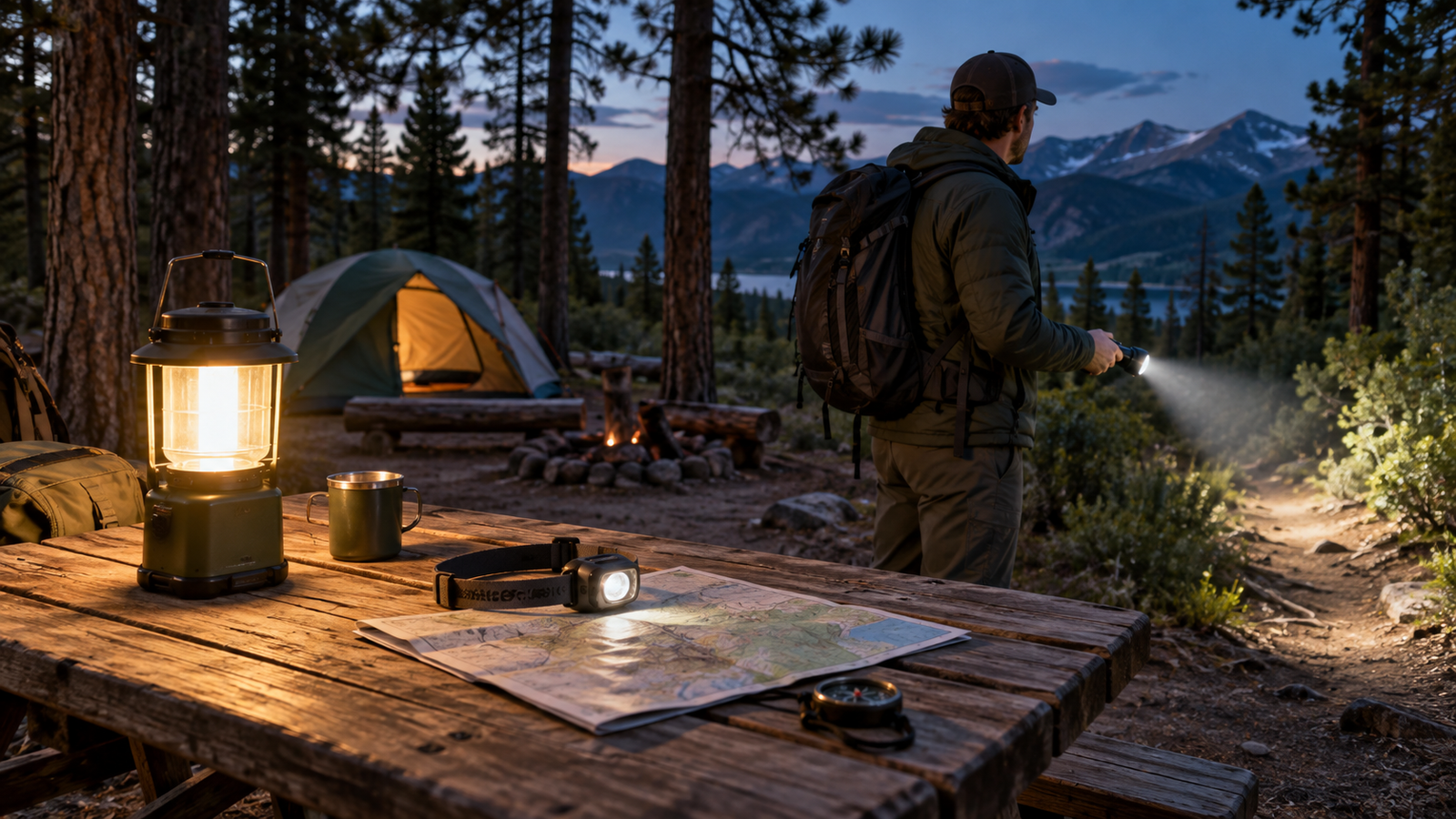
Learning how to choose a camping light is more important than simply buying the product with the largest lumen number. Campsite lanterns, handheld flashlights, and headlamps create different beam patterns and serve different purposes. The right combination helps you cook safely, organize equipment, follow a trail, and handle unexpected problems after dark.
This guide explains brightness, beam distance, battery systems, runtime, weather resistance, charging, and the practical differences between each type of light. It also provides straightforward recommendations for family camping, backpacking, emergency preparation, and everyday carry.
The Three Main Types of Camping Lights
Camping Lanterns: Best for Area Lighting
A lantern spreads light across a wide area instead of concentrating it into a narrow beam. It is the most comfortable choice for a picnic table, cooking station, tent interior, or shared sitting area. A well-designed lantern should provide several brightness levels so you can use strong light during setup and softer light when relaxing.
Lanterns are not ideal for seeing far down a trail. Their wide distribution uses light close to the campsite, and placing an overly bright lantern at eye level can create glare. Hang it above head height or place it slightly away from the group for more even illumination.
See a Rechargeable Camping Lantern on Amazon
Handheld Flashlights: Best for Distance and Control
A flashlight directs light exactly where you point it. This makes it effective for checking the trail, searching a vehicle, identifying a sound beyond camp, or examining equipment. Some models produce a broad flood beam, while others use a tighter spotlight for longer distances. Premium multipurpose lights may provide both.
A handheld light gives precise control but occupies one hand. It works best as a secondary light alongside a lantern or headlamp rather than the only light at camp.
Headlamps: Best for Hands-Free Tasks
A headlamp follows your line of sight and leaves both hands available. That is a major advantage when pitching a tent, preparing food, collecting firewood, walking a dog, repairing gear, or navigating a trail. Backpackers often consider a headlamp essential because it delivers useful light from a small and lightweight package.
Choose a comfortable adjustable strap and controls that are easy to operate with cold fingers. A low mode is valuable around other campers, and a red mode can help preserve night vision when reading maps or moving inside a tent.
See Rechargeable Headlamps on Amazon
How Many Lumens Do You Need for Camping?
Lumens measure the total amount of visible light a product emits. They are useful for comparison, but they do not describe beam shape, distance, color, or how long maximum output can be maintained. A focused 300-lumen beam may illuminate a distant object more effectively than a 1,000-lumen lantern that spreads light in every direction.
| Camping Task | Useful Brightness Range | Recommended Light |
|---|---|---|
| Reading inside a tent | 10–50 lumens | Low lantern or headlamp mode |
| Cooking and organizing gear | 100–300 lumens | Broad lantern or headlamp |
| Walking around camp | 100–400 lumens | Headlamp or flashlight |
| Trail navigation | 200–600 lumens | Headlamp with focused beam |
| Searching at a distance | 500+ lumens | Handheld spotlight |
| Emergency area lighting | 500+ lumens | High-output lantern |
These ranges are general guidelines rather than strict requirements. Reflective surfaces, fog, tree cover, battery level, and beam design all affect perceived brightness. Higher output also produces more heat and reduces runtime. For most routine camping tasks, an efficient medium mode is more useful than a short-lived turbo setting.
Beam Pattern Matters as Much as Brightness
- Flood beam: Wide and even illumination for cooking, repairs, tent setup, and nearby terrain.
- Spot beam: Concentrated light for identifying objects farther away.
- Mixed beam: A central hotspot surrounded by softer spill light, useful for general walking.
- Diffused lantern light: Broad light designed to reduce harsh shadows in a shared area.
Consider where the light will be used. Dense woodland and campsites benefit from a broad beam that reveals obstacles close by. Open terrain and search tasks may require greater beam distance. Some modern EDC flashlights combine separate flood and spot emitters, providing both options in one compact body.
See a Flood-and-Spot EDC Light on Amazon
Rechargeable vs. Replaceable Batteries
Rechargeable Camping Lights
Rechargeable lights reduce the cost and waste of disposable cells. USB-C charging is particularly convenient because the same cable may work with phones, power banks, solar generators, and vehicle adapters. Before traveling, confirm whether the product can operate while charging and whether its battery is replaceable.
Replaceable-Battery Lights
Standard batteries remain useful for long trips and severe-weather kits. A fresh set restores power immediately without waiting for a charging cycle. Store spare batteries separately, protect their terminals, and check them periodically for leakage or expiration.
What About Solar Charging?
A small solar panel on a compact lantern can provide emergency energy, but charging speed depends heavily on panel size, weather, angle, and hours of direct sunlight. Treat built-in solar charging as a backup feature. USB charging should normally be the primary method, and the lantern should be fully charged before leaving home.
See Solar and USB Camping Lanterns on Amazon
Understanding Runtime Claims
Runtime should always be evaluated together with brightness. A lantern may operate for many hours on its lowest setting but only a fraction of that time at maximum output. High-powered flashlights often step down automatically after several minutes to manage heat and protect the battery.
For realistic planning, look for runtime information at a medium setting. Test every light at home before a trip, recharge it fully, and carry a backup. Cold temperatures can temporarily reduce battery performance, so keep small rechargeable lights inside your pack or jacket when camping in winter.
Water Resistance and Durability
Outdoor lighting should tolerate ordinary moisture, but terms such as waterproof and weather resistant are not interchangeable. An IP rating gives more specific guidance:
- IPX4: Protection from splashing water from multiple directions.
- IPX6: Protection against powerful water jets.
- IPX7: Protection during temporary immersion under the manufacturer’s test conditions.
- IP67: Dust-tight construction plus temporary-immersion protection.
Water resistance can decline if seals are damaged or charging covers are left open. Keep ports clean, allow them to dry before connecting a cable, and do not assume a camping light is suitable for diving.
Light Color and Night Vision
Warm or neutral white light often feels more comfortable around camp and can render natural colors well. Cool white light may appear brighter and is common in high-output products. Red light is useful for low-level map reading and moving inside a tent because it causes less disruption to dark-adapted vision than a bright white beam.
Regardless of color, avoid shining any beam directly into another person’s eyes. UV emitters and laser-style pointing beams require additional care: never aim them at people, animals, aircraft, or reflective surfaces, and follow the manufacturer’s safety instructions.
Best Lighting Setup by Camping Style
| Camping Style | Recommended Setup |
|---|---|
| Family car camping | One central lantern, one headlamp per adult, and a backup flashlight |
| Backpacking | Lightweight rechargeable headlamp plus a small backup light |
| RV camping | Rechargeable lanterns for outdoor areas and a flashlight for inspections |
| Emergency preparedness | Multiple lanterns, replaceable batteries, rechargeable flashlights, and power banks |
| Fishing | Water-resistant headlamp plus a bright area lantern |
| Everyday carry | Compact flat flashlight with low, medium, and high modes |
Camping Light Safety Tips
- Test every light and charging cable before leaving home.
- Carry at least one independent backup light.
- Use low modes around other campers to prevent glare.
- Keep lithium-ion batteries away from fire and excessive heat.
- Do not charge a wet light or use a visibly damaged battery.
- Store lights where they can be reached easily in the dark.
- Lock high-output flashlights during transport when a lockout mode is available.
- Follow all manufacturer instructions for UV and pointing functions.
Final Checklist
- Does the light type match the task: area, distance, or hands-free use?
- Is the medium setting bright enough for normal camping?
- Is runtime listed for more than just the lowest mode?
- Can you recharge it with equipment already in your camping kit?
- Is the water-resistance rating appropriate for expected weather?
- Are the controls easy to use while wearing gloves?
- Is the light comfortable to carry or wear?
- Do you have a backup light and backup power source?
Conclusion
The best camping light is the one that matches a specific job. Use a lantern for comfortable shared illumination, a headlamp for hands-free movement and camp chores, and a flashlight for focused or long-distance viewing. Most campers are better served by a small lighting system than by a single extremely bright product.
Prioritize useful medium-mode runtime, an appropriate beam pattern, convenient charging, reliable weather protection, and controls you can operate easily. When those fundamentals are right, lumen output becomes one helpful specification instead of the only reason to buy.
Product features and specifications can change. Confirm current output levels, runtime, water-resistance ratings, package contents, price, and availability before purchasing.
Leave a Reply
You must be logged in to post a comment.