

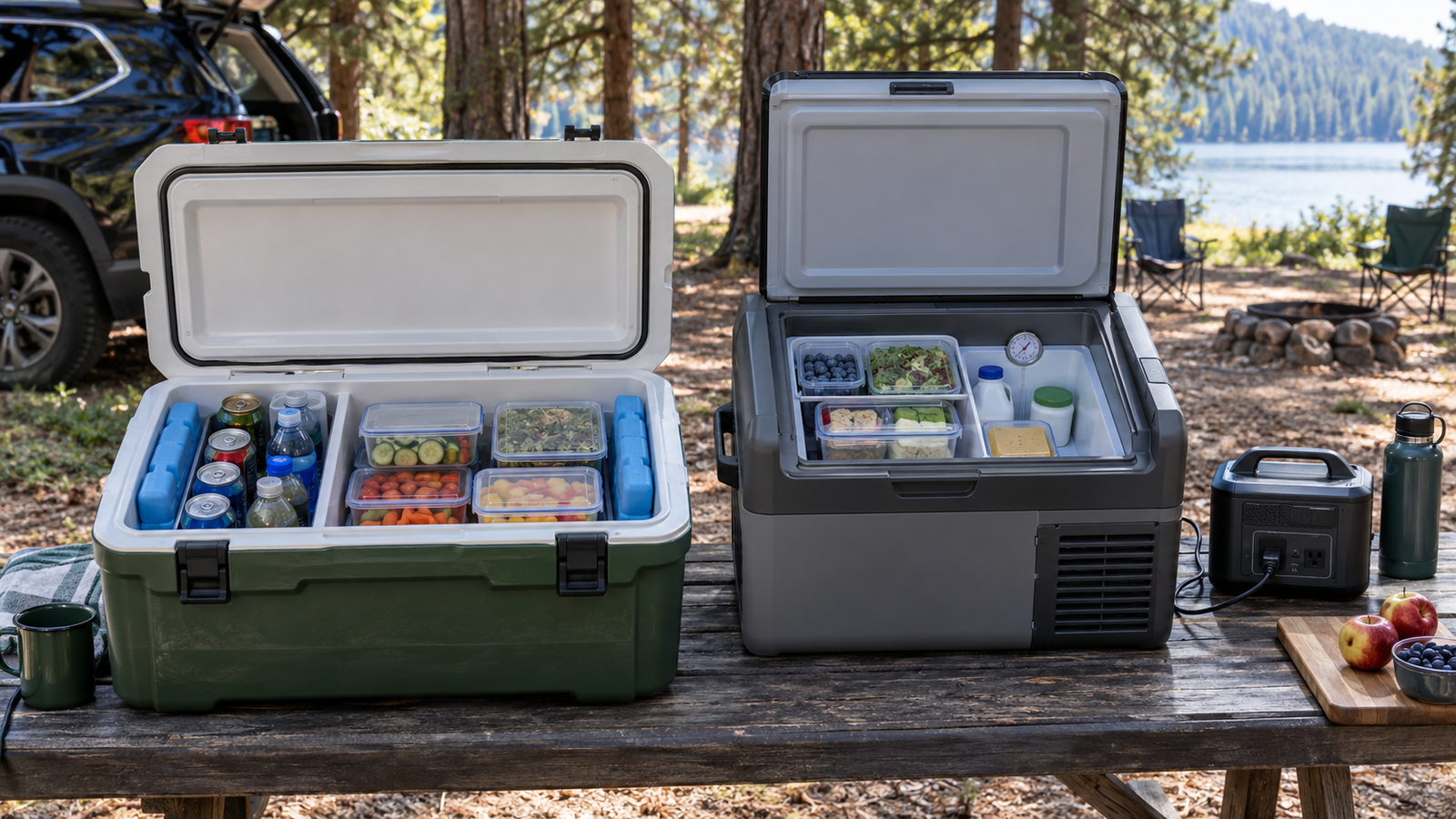
A camping cooler is more than a box for cold drinks. It protects food, reduces waste, and can determine whether a road trip or campsite kitchen runs smoothly. This guide explains how to choose a camping cooler, how traditional ice chests compare with 12V refrigerators, how much capacity you need, and how to pack and power the system safely.
Editorial note: This educational guide links to other 1 Way Camping resources, some of which contain affiliate links. Recommendations are based on practical use factors and official food-safety guidance.
Traditional Cooler or 12V Refrigerator?
The first decision is not brand or capacity. It is the cooling method. A traditional cooler uses ice or frozen packs and needs no electricity. A portable 12V refrigerator uses an active compressor and requires a continuous power plan.
| Consideration | Traditional Ice Cooler | 12V Portable Refrigerator |
|---|---|---|
| Power | No electricity | Vehicle, battery, power station, or AC adapter |
| Temperature control | Changes as ice melts | Set electronically within the model’s range |
| Usable space | Ice occupies part of the interior | No loose ice required |
| Maintenance during trip | Add ice and drain water | Monitor power and ventilation |
| Initial cost | Usually lower | Usually higher |
| Best use | Simple trips and remote sites | Road trips, RVs, vans, and repeat camping |
An ice cooler is often the better tool for a short weekend, a picnic, or a primitive campsite where electricity is unavailable. A 12V refrigerator is more convenient for repeated travel, longer journeys, temperature-sensitive foods, or anyone tired of buying ice and managing meltwater.
How Much Cooler Capacity Do You Need?
Capacity is commonly listed in quarts or liters, but the number alone does not tell the whole story. Internal dividers, compressor housings, baskets, and the shape of food containers all affect usable space. For an ice chest, you must also reserve substantial room for ice or frozen packs.
- 15–25 quarts: solo travelers, day trips, medicines or drinks, and small cars.
- 26–40 quarts: couples, weekend camping, fishing trips, and compact SUV setups.
- 41–55 quarts: versatile family range for multi-day food and beverages.
- 56–80 quarts: larger families, long road trips, RVs, group camps, or substantial frozen storage.
- Over 80 quarts: specialized group use where cargo space and lifting plans are already solved.
Do not automatically buy the largest model you can afford. A half-empty refrigerator still occupies full cargo space, and a large unit can become difficult to move when loaded. Measure the vehicle opening, floor area, lid clearance, cable route, and ventilation space before ordering.
Single Zone vs. Dual Zone
A single-zone refrigerator keeps one main compartment at one selected setting. It is simple, efficient to organize, and appropriate when everything needs refrigeration or everything needs freezing.
A dual-zone layout divides the interior into two compartments. It can help separate drinks from food or refrigerated items from frozen items. However, “dual zone” does not always mean two fully independent temperature controls. Confirm in the current manual whether both compartments have separate sensors and settings.
Food Safety: The Temperature That Matters
The U.S. Department of Agriculture advises keeping cold food at 40°F (4.4°C) or below. Bacteria can grow rapidly in the 40°F to 140°F “danger zone.” Use a refrigerator or appliance thermometer inside the cooler instead of trusting touch, outside weather, or the number on an unverified display. See the USDA temperature guidance.
Perishable food should generally not remain in the danger zone for more than two hours, or more than one hour when the outside temperature is above 90°F. When the temperature history is uncertain, the safest approach is to discard the food rather than taste it.
How to Pack a Traditional Ice Cooler
- Pre-chill the cooler. Cool the empty interior before loading whenever practical.
- Start with cold food. A cooler should maintain temperature, not chill warm groceries from room temperature.
- Use sealed, leak-resistant containers. Keep raw proteins isolated from ready-to-eat foods.
- Pack in meal order. Put later meals lower and frequently used items near the top.
- Fill empty space. A full cooler generally holds temperature better than a half-empty one; use additional frozen packs or frozen water bottles.
- Separate drinks. A second beverage cooler prevents repeated opening of the food cooler.
- Keep it shaded. Cover it with a light blanket or reflective cover without blocking any required features.
- Check the thermometer. Add ice when needed to keep food at 40°F or below.
How to Use a 12V Refrigerator Efficiently
- Pre-cool at home. If the model supports an AC adapter, bring the empty cabinet and food to temperature before departure.
- Load already chilled items. This reduces the initial compressor workload.
- Allow ventilation. Keep air inlets and exhaust vents clear on every side specified by the manufacturer.
- Use baskets and containers. Organized air space makes food easier to reach and reduces lid-open time.
- Secure the unit. Prevent movement during braking or rough-road travel without placing straps across controls or vents.
- Protect it from direct sun. Shade lowers heat load, but never wrap the compressor area tightly.
- Test the complete system. Check cables, plugs, fuses, settings, and the intended battery before the trip.
Understanding the Power Plan
A 12V refrigerator does not run continuously at its maximum rating; the compressor cycles as needed. Actual energy use changes with ambient heat, set temperature, insulation, ventilation, food temperature, lid openings, and whether the appliance is refrigerating or freezing.
For planning purposes, begin with the manufacturer’s rated power and your realistic hours of use. A portable power station is rated in watt-hours (Wh). A simplified estimate is:
Estimated runtime = usable battery watt-hours ÷ average refrigerator watts
This is only a planning estimate. Conversion losses, battery protection limits, cable condition, hot weather, and compressor cycling change the result. Test the refrigerator with your actual power station before relying on it in the field. Avoid running it overnight from a vehicle starter battery unless the vehicle and appliance instructions explicitly support that use and suitable low-voltage protection is active.
Important Features Worth Checking
- External and internal dimensions: both cargo fit and container fit matter.
- Empty weight and handles: capacity becomes heavy once loaded.
- Wheels: useful for large units on firm surfaces, less helpful on rocks or deep sand.
- Power inputs: confirm 12V/24V DC, AC adapter availability, cable length, and plug type.
- Battery protection: useful, but not a substitute for a proper auxiliary-power plan.
- Temperature range: verify whether it truly reaches your refrigeration or freezing goal.
- Drain and removable basket: simplify cleaning.
- Lid direction and clearance: essential when installed in a packed vehicle.
- Warranty and support: especially important for compressor appliances.
Cleaning and Storage
Disconnect power before cleaning an electric refrigerator. Remove food, baskets, and standing water. Wipe the interior with mild soap and a soft cloth, then follow the manufacturer’s instructions for sanitizing and drain care. Do not flood control panels, electrical connectors, or compressor vents.
Dry the unit completely before storage. Leave the lid slightly open to prevent trapped odors and mildew, and keep the power cable loosely coiled rather than sharply bent. Inspect the lid seal, plug, fuse, and ventilation openings before the next trip.
Common Mistakes to Avoid
- Loading warm food immediately before departure.
- Choosing capacity without measuring the vehicle.
- Blocking compressor vents with luggage or blankets.
- Opening the food cooler every time someone wants a drink.
- Assuming a display temperature always matches the warmest food location.
- Relying on a starter battery for unattended overnight cooling.
- Ignoring total loaded weight and lifting technique.
- Placing raw food where leakage could contaminate ready-to-eat items.
Frequently Asked Questions
Is a 12V refrigerator better than an ice cooler?
It is better for active temperature control and long road-based travel, but an ice cooler is better when simplicity, lower initial cost, and freedom from electricity are the priorities.
What temperature should a camping cooler maintain?
Keep perishable cold food at 40°F (4.4°C) or below. Verify the interior with an appliance thermometer.
What size cooler is best for a family?
Many families find the 41- to 55-quart range versatile, but trip duration, group size, beverage volume, and whether ice occupies interior space can change the answer.
Next Step: Compare Real Models
Once you know the right cooling method, capacity, and power plan, review our comparison of eight camping coolers and 12V refrigerators. It covers compact, family-size, dual-zone, power-free, and high-capacity options without forcing one design to fit every camper.
Final Takeaway
The best cooler is the one that fits your food plan, cargo space, trip length, and available energy. Choose ice for independence and simplicity. Choose a 12V refrigerator for controlled cooling and repeat road travel. Whichever system you use, pre-chill it, organize it carefully, monitor the real interior temperature, and protect it from unnecessary heat.
Leave a Reply
You must be logged in to post a comment.