

Disclosure: As an Amazon Associate, 1WayCamping may earn from qualifying purchases made through links in this article, at no extra cost to you.
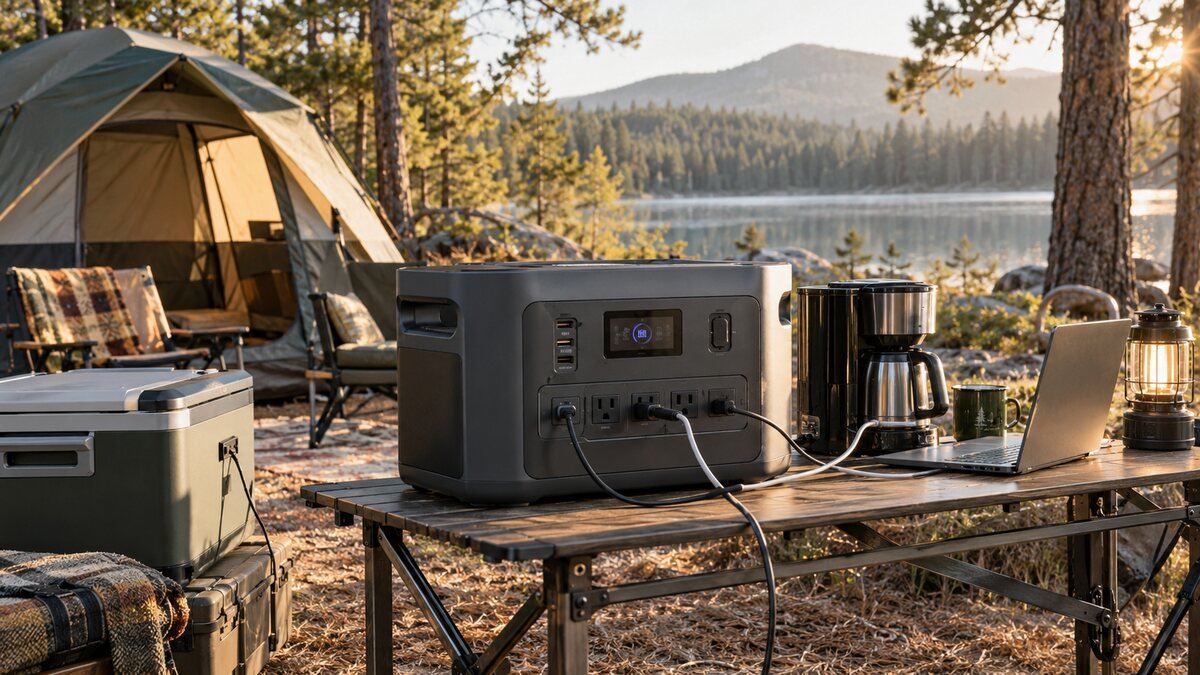
The EF ECOFLOW DELTA 2 Max occupies a useful middle ground between compact camping batteries and very large home-backup systems. Its 2048Wh LiFePO4 battery, 2400W continuous AC output, fast charging, expandable capacity, and 1000W maximum solar input make it suitable for RV travel, family car camping, cabins, mobile work, and selected household essentials during an outage. This EcoFlow DELTA 2 Max review examines what those specifications mean in practice and where its limitations begin.
EcoFlow DELTA 2 Max specifications
- Battery capacity: 2048Wh
- Battery chemistry: LiFePO4 (LFP)
- AC output: 2400W continuous
- Surge output: up to 4800W
- X-Boost: supports selected appliances up to approximately 3400W
- Expandable capacity: up to 6144Wh with compatible extra batteries
- Solar input: up to 1000W under supported conditions
- AC charging: approximately 80 minutes for a full charge under specified conditions
- Weight: approximately 50 lb (23 kg)
- Dimensions: approximately 19.6 × 9.5 × 12 inches
At around 50 pounds, the DELTA 2 Max is reasonably movable between a vehicle and a nearby campsite, but it is not designed for hiking. The integrated handles help two-handed lifting. Its natural environments are car camping, an RV, a cabin, a workshop, or a fixed emergency-power location.
How useful is a 2048Wh battery?
A 2048Wh capacity can support far more than phone charging. At camp, it can operate lighting, laptops, cameras, fans, a portable refrigerator, and other equipment. During an outage, it may power communications devices and selected appliances. Exactly how long it lasts depends on the combined load and how each device cycles.
The rated capacity is not the same as energy delivered at the outlets. The inverter and internal electronics consume power, while temperature and battery condition also affect performance. For a rough runtime estimate, divide the realistically usable watt-hours by the appliance’s average wattage. Compressors and pumps may have startup surges, so check both running and starting requirements.
2400W output and X-Boost explained
The 2400W continuous AC inverter is a major advantage over many smaller portable stations. It can run several common devices together as long as their combined continuous demand remains within the rating. The 4800W surge capacity helps accommodate brief startup loads; it is not a continuous power figure.
EcoFlow’s X-Boost feature can allow selected resistive appliances rated up to roughly 3400W to continue operating by adjusting voltage. This does not convert the station into a normal 3400W continuous generator. X-Boost may be inappropriate for sensitive electronics or devices that require precise voltage. Follow the appliance and power-station instructions rather than relying only on the headline number.
Fast AC and dual charging
EcoFlow states that the US version can accept up to 1800W from AC and reach a full charge in about 80 minutes under supported conditions. That is useful when preparing for a trip or restoring capacity during a short stop. Actual charging time varies with temperature, household circuit limits, battery state, and app settings.
Combining compatible AC and solar input can shorten charging under favorable conditions. The required panels and accessories may be sold separately, so buyers should include them in the complete system budget.
Solar charging for camping
The maximum 1000W solar input makes the DELTA 2 Max appealing for extended stays away from outlets. Reaching that input requires a properly configured array within the station’s supported voltage and current limits. Real-world output is affected by clouds, shade, panel angle, heat, wiring losses, and the time of day.
Campers should first estimate daily consumption and then select enough panel capacity to replace it during realistic sunlight hours. A portable refrigerator and small electronics are easier to sustain than electric cooking or space heating. Solar power extends runtime, but it does not make the battery unlimited.
LiFePO4 battery and expected service life
The DELTA 2 Max uses LiFePO4 cells, a chemistry valued for long cycle life and thermal stability. EcoFlow rates it for approximately 3,000 cycles before reaching 80% of its original capacity under specified conditions. The battery can continue functioning beyond that point, although it will need recharging more often.
Keep the unit dry, maintain clear ventilation, avoid extreme storage temperatures, and follow the manufacturer’s long-term storage recommendations. A powerful inverter can generate heat under a heavy load, so the power station should never be enclosed in a compartment without airflow.
Expandable capacity and app control
One compatible Smart Extra Battery raises the system capacity, while two can expand it to 6144Wh. Expansion is valuable for longer outages or RV stays, but it also increases cost, weight, and storage space. Buyers who only occasionally need 2kWh may prefer the simplicity of the base unit.
The EcoFlow app provides remote monitoring and access to settings through supported wireless connections. Users can view charging and discharge information, adjust limits, and manage features without standing beside the unit. The onboard display still provides essential information when a phone is unavailable.
Best uses for the DELTA 2 Max
- Family car camping with refrigeration, lighting, and device charging
- RV travel and quiet campground power
- Cabins and off-grid base camps with compatible solar panels
- Mobile offices, photography, and outdoor work
- Short household outages involving selected essentials
Pros and cons
Pros
- Useful 2048Wh base capacity
- Strong 2400W continuous AC output
- Long-life LiFePO4 battery
- Fast AC charging
- Up to 1000W solar input
- Expandable to 6144Wh
- App monitoring and multiple output options
Cons
- Approximately 50 pounds and unsuitable for backpacking
- Expansion batteries and solar panels can add considerable cost
- High-wattage heating appliances drain the battery quickly
- X-Boost is not equivalent to full 3400W continuous output
- Real solar charging depends on weather and panel placement
Who should buy it?
The DELTA 2 Max is best for campers and RV owners who need more capability than a 1kWh station but want something easier to transport than a 3.6kWh flagship unit. It also suits households seeking portable backup for selected essentials. Backpackers and occasional phone-only users should choose a smaller model, while buyers planning whole-home backup may need a larger integrated system.
Final verdict
The EF ECOFLOW DELTA 2 Max offers a well-balanced combination of 2048Wh capacity, 2400W continuous output, fast charging, substantial solar input, and expandable LFP storage. Its 50-pound weight is manageable for vehicle-based use but too heavy for trail travel. For family camping, RV trips, and moderate emergency backup, it delivers more flexibility than a compact station without committing buyers to the bulk of the largest systems.
Leave a Reply
You must be logged in to post a comment.