

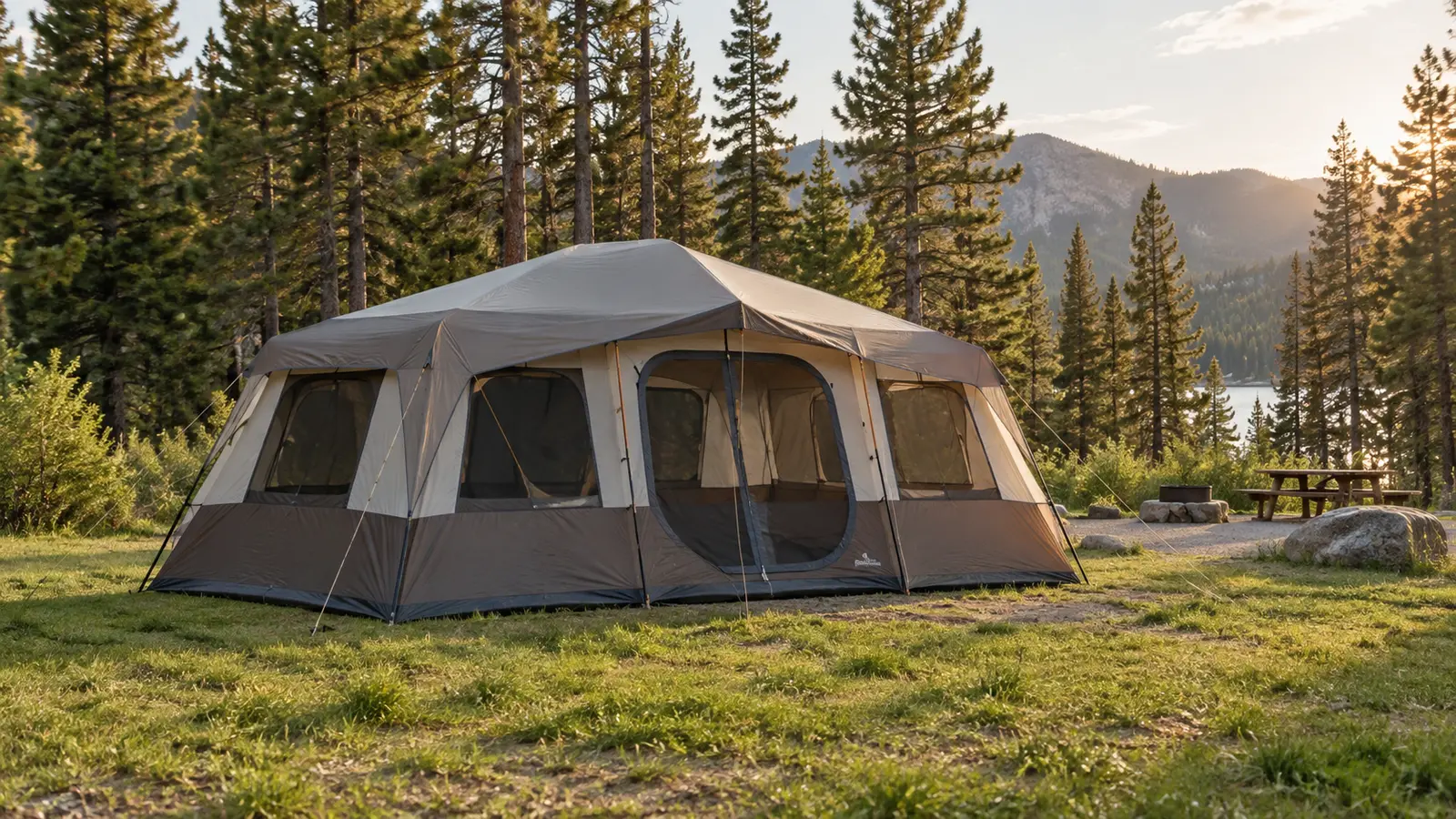
Family camping becomes more comfortable when a tent provides enough space for sleeping, standing and storing equipment. The Naturehike KOTA Camping Tent is designed to meet those needs with a tall double-layer structure and a large vestibule that extends beyond the sleeping compartment.
The Amazon listing groups options marketed for four, six and eight people. These configurations provide different amounts of interior space, but share an emphasis on ventilation, weather protection and flexible use.
The KOTA is not an instant or ultralight tent. Its conventional pole-supported construction requires more assembly than the Naturehike Village series. In exchange, campers receive aluminum poles, a full double-wall design and a substantial covered vestibule.
Affiliate disclosure: This article contains affiliate links. If you purchase through one of these links, we may earn a commission at no additional cost to you.
How We Evaluated the Naturehike KOTA
This research-based overview uses current specifications from Naturehike and the Amazon product listing. We have not represented every configuration as personally field-tested by 1 Way Camping.
The listed dimensions and capacities vary by model. Confirm the exact KOTA option selected before completing your purchase.
Naturehike KOTA Overview
The KOTA is a large tunnel-style family tent that combines a freestanding mesh inner tent with an extended external shelter.
Its principal advertised features include:
- Options for four, six or eight campers.
- Double-layer construction.
- Large covered vestibule.
- Tall interior with standing room.
- 75D 210T polyester fabric.
- PU 3,000 mm or greater waterproof rating.
- Aluminum-alloy poles.
- Large mesh windows.
- Additional ventilation openings.
- Separate inner and outer components.
- Four-season manufacturer designation.
- Multiple-use outer shelter.
The current Naturehike KOTA Amazon listing has a 4.3-star rating based on more than 140 customer ratings at the time of review. Ratings and availability may change.
Selected Specifications
The six-person version currently provides the most complete published specifications:
| Feature | Six-person KOTA |
|---|---|
| Shelter dimensions | 212.6 × 99.2 × 80.7 in |
| Metric dimensions | 540 × 252 × 205 cm |
| Inner tent | 120.8 × 96 × 78.7 in |
| Inner tent metric size | 307 × 244 × 200 cm |
| Listed weight | Approximately 21.1 lb |
| Outer material | 75D 210T polyester |
| Waterproof rating | PU 3,000 mm+ |
| Pole material | Aluminum alloy |
| Windows | Two large mesh windows |
| Additional ventilation | Two air vents |
| Construction | Double layer |
| Recommended capacity | Six sleepers |
The overall 212.6-inch length includes the extended vestibule, not only the enclosed sleeping compartment.
How the Sizes Differ
Four-person KOTA
Naturehike lists the KOTA four-person model at approximately:
- Overall dimensions: 181 × 107 × 77 inches.
- Metric dimensions: 460 × 273 × 195 centimeters.
- Weight: Approximately 15.87 pounds.
- Material: 75D 210T polyester with waterproof coating.
The four-person version is likely the most manageable choice for couples and small families. Its long exterior footprint still provides a substantial vestibule.
Six-person KOTA
The six-person version has a shelter measuring approximately 212.6 × 99.2 × 80.7 inches. Its inner bedroom measures approximately 120.8 × 96 inches and reaches nearly 79 inches in height.
This version may be suitable for a family of four seeking generous living and storage space.
Eight-person option
The eight-person designation may refer to the number of people who can use the complete shelter for activities or to a larger variation within the grouped Amazon listing. Exact dimensions should be confirmed after selecting this option.
For comfortable overnight use, do not assume that the largest advertised number represents spacious sleeping capacity with equipment.
Realistic Capacity
The capacity stated by a tent manufacturer generally represents the maximum number of sleeping positions. It rarely includes space for large backpacks, mattresses, cots or furniture.
A practical sizing guide is:
| Camping group | Recommended KOTA capacity |
|---|---|
| Two adults with equipment | Four-person |
| Two adults and one or two children | Four- or six-person |
| Family of four wanting more room | Six-person |
| Five or six campers | Six- or eight-person |
| Large family with substantial equipment | Largest available option |
Selecting a tent rated for at least two more occupants than your actual group usually provides a more comfortable arrangement.
Large Vestibule and Covered Porch
The extended vestibule is one of the KOTA’s strongest features. It creates a covered area outside the inner sleeping compartment that can be used for:
- Storing backpacks and footwear.
- Keeping muddy equipment away from bedding.
- Providing shade during the day.
- Organizing camping furniture.
- Preparing equipment during rain.
- Creating a protected transition between outdoors and the bedroom.
The vestibule floor may not provide the same sealed protection as the inner sleeping compartment. Keep electronics and other moisture-sensitive items in waterproof containers.
Never operate a grill, stove or fuel-burning heater inside the vestibule. Even a partially open tent can accumulate carbon monoxide or catch fire.
Double-Layer Design
The KOTA combines a mesh inner tent with a separate polyester outer shelter. This construction provides greater flexibility than a single-wall family tent.
Inner tent alone
During warm, dry weather, the mesh inner tent can be used separately. This provides maximum ventilation and an open view of the sky while maintaining insect protection.
Outer shelter alone
Naturehike states that the outer layer can function separately as a canopy, sun shelter or rain shelter. This could be useful for picnics, outdoor gatherings or daytime campground activities.
Complete double-wall configuration
Combining both layers provides the greatest protection and privacy. The space between the inner and outer sections also helps manage condensation.
Waterproof Construction
The KOTA uses 75D 210T polyester with a listed polyurethane waterproof rating of at least 3,000 mm. This is stronger on paper than the ratings offered by many entry-level family tents.
The listed rating applies to the fabric under controlled testing. Complete tent performance still depends on seam construction, setup quality, ground drainage and rain duration.
For better protection:
- Select elevated ground.
- Avoid areas where water can pool.
- Stake the shelter at every recommended point.
- Tension the fly evenly.
- Use all appropriate guy lines.
- Maintain separation between the fly and inner tent.
- Keep bedding away from the walls.
- Use a properly sized footprint beneath the bedroom.
A footprint should not extend beyond the tent floor because exposed material can collect rainwater.
Aluminum-Alloy Poles
Aluminum poles generally provide a favorable balance between strength, weight and repairability. They are also less likely than fiberglass poles to split into sharp fragments.
The KOTA’s long tunnel-style structure depends on its poles, stakes and guy lines working together. Campers should inspect each connection before use and carry a compatible repair sleeve.
Aluminum can bend under sufficient force, so the tent should still be taken down when dangerous winds or severe storms are forecast.
Setup Expectations
The KOTA is not an instant tent. Naturehike describes the four-person version as using a straightforward pole-threading process.
A typical setup involves:
- Spreading the outer or inner tent on the ground.
- Connecting the aluminum pole sections.
- Passing poles through their designated sleeves.
- Raising the main structure.
- Attaching the inner tent when required.
- Staking all corners and vestibule points.
- Tensioning the guy lines.
- Adjusting the fly for proper separation.
Because of its length, the six- and eight-person configurations will be easier to pitch with two adults. Practice at home before your first trip.
Standing Height
The six-person model reaches approximately 80.7 inches at its maximum height. Its inner tent is approximately 78.7 inches tall.
This provides standing room for many adults and makes several campsite activities more comfortable:
- Changing clothes.
- Arranging mattresses.
- Assisting children.
- Organizing sleeping bags.
- Entering and leaving the bedroom.
- Managing equipment during rain.
The four-person version also offers substantial height at approximately 77 inches.
Ventilation and Condensation
The six-person listing describes two large mesh windows and two additional air vents. The mesh inner tent can also promote airflow throughout the sleeping area.
To reduce condensation:
- Open windows on opposite sides.
- Keep all vents unobstructed.
- Maintain separation between the inner tent and fly.
- Avoid bringing wet clothing into the bedroom.
- Do not press sleeping bags against the walls.
- Dry every component before storage.
A large group produces considerable moisture overnight. Proper ventilation remains necessary even in cold weather.
Four-Season Design: What It Really Means
Naturehike describes the KOTA as a four-season family tent. Its full outer shelter, strong waterproof rating and double-wall construction provide more coverage than many summer-only tents.
However, the long tunnel structure and large vestibule are not equivalent to a compact alpine expedition tent. Performance in snow depends on:
- Snow weight and accumulation.
- Pole strength.
- Wind direction.
- Stake security.
- Guy-line tension.
- Campsite exposure.
- Regular removal of snow from the roof.
The KOTA is better considered a versatile family shelter for varying campground conditions than a specialized mountaineering tent.
Packed Weight and Transportation
The four-person version weighs approximately 15.87 pounds, while the six-person model weighs around 21 pounds.
These weights make the KOTA suitable for:
- Car camping.
- Family campgrounds.
- Road trips.
- Base camps.
- Festivals.
- Extended stays in one location.
- Short carries from a parking area.
It is not suitable for ordinary backpacking despite the “hiking” terminology included in some listings. Its long footprint and multiple poles also require substantial campsite space.
Advantages
The principal advantages include:
- Spacious sleeping compartment.
- Large covered vestibule.
- Standing height.
- Double-layer construction.
- PU 3,000 mm+ waterproof rating.
- Aluminum-alloy poles.
- Flexible inner and outer sections.
- Mesh ventilation.
- Better weather coverage than many basic cabin tents.
- Multiple capacity options.
Potential Disadvantages
Consider these limitations:
- Not an instant tent.
- Requires more setup than a cabin pop-up.
- Large overall footprint.
- Too heavy for backpacking.
- Six- and eight-person versions are easier with two people.
- Maximum capacity may feel crowded.
- Tunnel structure depends heavily on secure staking.
- Large vestibule adds weight and setup complexity.
- Exact specifications vary by Amazon option.
Naturehike KOTA Versus Naturehike Village
| Feature | Naturehike KOTA | Naturehike Village |
|---|---|---|
| Setup system | Conventional pole-supported | Instant frame |
| Weather coverage | Full double-wall shelter | Depends on version |
| Vestibule | Large and prominent | Smaller or model dependent |
| Poles | Aluminum alloy | Integrated frame |
| Setup speed | Slower | Faster |
| Packed convenience | More separate components | Bulkier attached structure |
| Best use | Longer family trips | Quick campground trips |
| Backpacking | Not recommended | Not recommended |
Choose the KOTA if weather coverage and vestibule space are priorities. Choose the Village if rapid setup matters more.
Who Should Buy the KOTA?
The Naturehike KOTA Camping Tent may be a good choice for:
- Families wanting a separate covered living area.
- Couples seeking abundant space.
- Campers expecting occasional rain.
- Taller campers who value standing room.
- Groups staying several nights in one location.
- Families camping primarily by vehicle.
- Campers who prefer aluminum poles.
It may not be ideal for:
- Ultralight backpackers.
- Campers wanting instant setup.
- Very small campsite pads.
- Solo campers seeking a compact shelter.
- Extreme alpine expeditions.
- Groups unwilling to spend time staking a large tent.
Care and Safety Tips
To extend the tent’s life:
- Practice setup before traveling.
- Use every recommended guy line.
- Dry both layers completely before storage.
- Clean the fabric with mild soap and water.
- Avoid machine washing.
- Inspect aluminum poles for bends.
- Protect the floor with a suitable footprint.
- Keep flames and heaters outside.
- Store the tent in a cool, dry place.
- Carry a fabric patch and pole-repair sleeve.
Final Verdict
The Naturehike KOTA 4/6/8 Person Camping Tent stands out for its large vestibule, tall interior and flexible double-layer construction.
Its 3,000 mm+ waterproof rating and aluminum poles provide stronger specifications than many inexpensive family cabin tents. The mesh inner tent and independent outer shelter also give campers several configuration options.
The trade-offs are slower assembly, a large campsite footprint and considerable weight. It is a car-camping shelter rather than an instant tent or backpacking model.
The four-person KOTA is the most manageable choice for couples and small families. The six-person model offers an excellent balance of bedroom space, standing height and covered living area for a family of four. Larger groups should carefully verify the dimensions and sleeping layout of the eight-person option.
Suggested Amazon Button
Check Available KOTA Sizes and Current Price on Amazon
Dimensions, weight and capacity vary between configurations. Confirm the selected Naturehike KOTA model before completing your purchase.
Leave a Reply
You must be logged in to post a comment.